
Saturday, July 15, 2017

Friday, July 14, 2017
Real Life Discounts.
 If you wonder what happened to yesterday's entry, I am visiting family and took the day off to visit with them. I'm back.
I am on a list which sends out daily e-mails suggesting eBooks I might be interested in purchasing. These are books that might be $7.99 normally but are on sale for $0.99.
This is a perfect to use in the math class when discussing discounts. The ads do not give the percent discount so it is easy to have students calculate it.
To take it one step further, students could go to various online sites such as amazon, wal-mart, or others to shop for items they'd like. Most sites list the manufacturers suggested retail price and the price the item is being sold at. Some even give a percent discount. Students can calculate the percent discount if not listed, check the site's accuracy for discount, and compare which site is a better buy for each item, or see which site is the best site to purchase everything from.
Throw in a discussion of manufacturers suggested retail price(MSRP) vs the actual price charged, the items which are generally sold using the MSRP vs those that are generally offered at less than the MSRP. Most books are sold at the cover price which is the manufacturers suggested retail price unless you belong to a plan which gives an automatic discount or things are on sale.
I love applying the MSRP to purchasing automobiles and other vehicles because the sales price is always compared to the MSRP but they never seem to give the discount as a percent, only as an amount. I think most people are excited by the fact you get money off they don't look at the actual percent.
The reason I chose online is because they list more information on the ad than the stores have on the shelf. In addition, it is fun to take the price the object online and compare it to the price the same item costs in the store. It it really cheaper to order it or is it cheaper locally. For me, in my situation, its often easier to order from someone than to try to find it in town but every situation is different.
Let me know what you think and I'd love to hear from you.
Wednesday, July 12, 2017
Splat
Steve Wybourney, author of The Writing On The Classroom Wall, shared 50 regular splats and 20 fraction splats. A splat is one or more ink blots which cover a certain number of dots. The idea is for the student to use the information provided to find an answer.
Each activity is set up as a power point but works as well in keynote. The activity walks the student through each step On the first activity of each bundle guides students through the process so they know what is expected. One step includes having students think of possible combinations or totals which is one way to have students develop number sense.
Towards the end of each splat, the answers are revealed but only after students have a chance to think about their answers including the opportunity to explain their thinking.
The fraction splats operate in the same manner except students see a combination of whole and factional circles. They look at the total before a splat covers some of them. It is up to the student to workout the fraction covered by the splat.
I will be teaching a basic math course for students who are well below grade level and a pre-algebra for students who are only a little below grade level. I can see using these for both classes as a way for students to develop number sense. Most of mine arrive in high school without having developed number sense.
I can hardly wait to use them. In the meantime check them out and let me know what you think.
Tuesday, July 11, 2017
Why Use Consistant Units.
As I mentioned in yesterday's column, Puerto Rico does not use consistent units. This definitely
leads to confusion if you are not used to this. Many of my students see no reason for making sure
they all use the same units of measurement.
One reason for using the same units is to increase communication so everyone is on the same page. We have all heard stories of something two companies built but the final product did not work because the two companies used different systems.
The perfect example can be found if you look at the Mars Climate Orbiter from 1998. The Jet Propulsion Laboratory (JPL) in Pasadena worked with Lockheed Martin Aeronautics in Denver on the software. Unfortunately, JPL did all their calculations in metric while Lockheed Martin used the English system of feet, inches, etc.
This lead to the space craft entered the Mars atmosphere at the wrong angle and was lost. What makes this so sad, is the fact neither group caught the error in all the months they worked together. This error resulted in a 125 million dollar ship being destroyed.
If you look back to 1983, you will find the story of a Jet plane running out of fuel due to a mistake in converting units. Air Canada's Boeing 767 ran out of fuel a routine flight because someone thought the fuel weight was in kilograms when it was actually in pounds. As you know 1 kilogram = 2.2 lbs. This means the plane had half the fuel it should have had. Fortunately, the two pilots onboard had gliding experience and were able to safely land the plane.
This is not a recent occurrence. It has been happening since the Vasa Warship was built back in the 1600's. Apparently the ship was asymmetrical because builders used the 12 inch Swedish ruler while the other side used the Austrian 11 inch ruler and these folks were working in the same shipyard!
The final example is the Laufenberg bridge built back in the early 2000's. The bridge straddles Germany and Switzerland. The problem arose because each country defines sea level. This caused one side to to be 54 cm higher than the other side. In other words one side was taller than the other.
So the next time students wonder about the importance of using the same units, you can share these examples. Let me know what you think.
Monday, July 10, 2017
Crazy Math
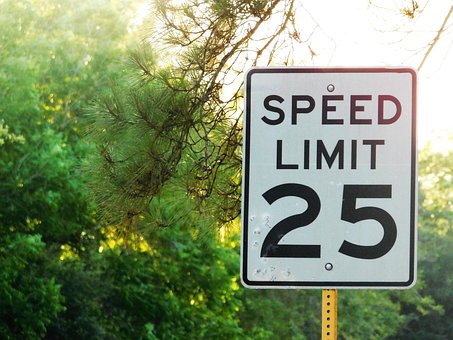 As you know, I've been traveling and currently I am in San Juan, Puerto Rico for a conference. The conference is almost over and I'll be hitting the road again, heading for Washington state.
In the math classes, I stress using all one system of measurement to make sure all units are consistent but I got a shock the other day on the way out to the radio telescope in Aerocibo, Puerto Rico.
As the bus traveled on the toll road, I noticed all the markers along the side of the road were in kilometers. We use them to check mileage along any road so if we have to call in for assistance, we can tell them we are at mile 35.7 or at kilometer 22.3. Signs showing the distance to the next town are also in kilometers but the speed limit signs are in miles per hour!
You read that right. Speed limits are in miles per hour which can make things really confusing. I had to ask to make sure it was miles per hour and not kilometer per hour because the posted speed limit was 65 and 55. No unit designation on it.
The guy sitting next to me on the bus was as confused as me when we saw those numbers. Although, Puerto Rico is a territory of the United States, it mixes English measurement with metric. For instance, gas is sold per liter while tomatoes are per pound. My taxi driver tried to tell me gas was only $1.29 per gallon yet sold for 60 cents per liter. I don't think he knows the real conversion rate. He also said each gallon has 5 liters.
I checked out some real estate adds for houses in the area. The main unit is meters squared with some translation into standard measurements but I'm not sure if the unit is for the house or the land. That part wasn't that clear. I did not watch any local television stations so I do not know if temperatures are given in Celsius or Fahrenheit.
When school starts in the fall, I can share the unique mix of systems with my students. I plan to take time to explain how confusing it was to see things in one or the other or both depending. This is the first place I've ever been where I've seen both systems used.
Let me know what you think. Puerto Rico appears to be the exception to the rule. Have a good day and enjoy yourself.
Sunday, July 9, 2017

Saturday, July 8, 2017

Subscribe to:
Posts (Atom)