Wednesday, February 14, 2018

Online Calculators and Apps

Calculator, The Hand, Calculate, Count  It finally happened in my class.  One of my students used an online calculator to factor trinomials with a leading coefficient of one.  It was easy to tell she'd done it.

First, she usually struggles with signs and tends to get them wrong so when she turned in the work in less than 30 minutes with only the answers and all the answers were correct, I knew she'd done something.

Rather than accuse her of anything, I gave her a quiz a couple days later.  She failed it miserably so I made a comment in passing that I asked them to show work so I could see her thinking and determine where she still needed help and when she goes online to find answers, it means she doesn't get a chance to learn the process. She just grinned and did all the problems again but this time included the work and made the same errors she's made in the past when working with integers.

As you know there are more and more tools on the internet or as apps which either give the answer to problems or provide the steps. Some of the apps are beginning to include written information for each step. I used one of the apps to solve 2x + 1 = 8

If you look at the above screen, it shows the steps with writing explanations for each step.  This makes it possible for students to write down each step with explanations but if the teacher requires complete sentences, students have to add sentences because most of use will not accept 1-1=0 as a complete sentences.

Still this is a step in the right direction as long as students actually read the steps, they can learn from this type of app.  The one I used is called snap chat.  It does read hand written equations so one can write it on a paper, snap, and voila but the app requires an internet connection to use.  That is only a problem if you do not have internet or its not reliable. 

Let me know what you think.  I'd love to hear.

Tuesday, February 13, 2018

Tangrams and Fractions


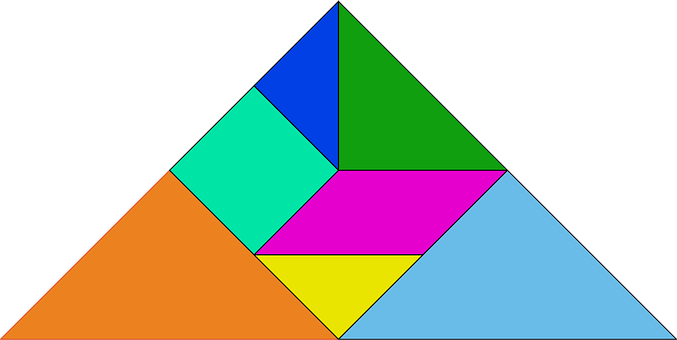
Chinese, Game, Shapes, Puzzle, Tangram  Being the only high school math teacher, the secretaries put all the catalogues with math things in my box.  Usually I throw them away without looking in them but the other day, I decided to check out the books just because I'm looking for new ideas.

I came across a book on using Tangrams to teach fractions.  That sparked my curiosity because I've used them to teach geometry concepts of convex and concave but never for fractions.

One way to use Tangrams to teach fractions is to have students make their own out of the stiffer construction paper.  Students use a 6 by 6 inch piece to create the set.  They start by folding the paper in half from corner to corner and then cut along the line so they now have two triangles.  Take one triangle and fold it again in half to make two smaller trangles so you have two like the tan and light blue ones.

The student then takes the point of the other triangle and fold it to the midpoint of the longest side.  Cut off the triangular piece at the top so you are left with an isosceles trapezoid.  This triangle is the green one. Fold it in half so you have a right trapezoid shape before unfolding.  Then take the corner on the longer side and fold it to the middle on the longer side before unfolding it.  Then fold the opposite short corner on the other side of the middle fold to the midpoint opposite.  Then unfold it.  You should see two smaller triangles such as the darker blue and yellow ones on each side of a square and the parallelogram.  Cut the shapes and there are the seven pieces of the Tangram.

Each of the two large triangles represent one fourth of the total shape.  The parallelogram, square and mid-sized triangle represent one eight each of the total shape.  The two smallest triangles each represent one sixteenth of the square.  If these directions do not make sense, check out this site with the directions and worksheets.


If you check out page one of this pdf, you'll see it assigns values of one to various shapes in the Tangram so students are looking at fractions greater than one.  In addition, this pdf has students taking their learning and applying it to several nontraditional Tangrams to determine the fraction of each shape.  It makes a nice extension activity requiring transference of knowledge.

If you wonder why I'm addressing the topic of fractions in a blog that looks at topics for middle school and high school, I have students who arrive in 9th grade who do not have a firm foundation in fractions and struggle.  The above topic gives them a different perspective to fractions and might be the one item they need to help them understand the topic.

If you need to you can extend this topic by having students change the fractions into decimals and percents if you need to work on showing the relationship between the three.

Let me know what you think, I'd love to hear. Have a great day.

Monday, February 12, 2018

Alpine Skiing and Slopes

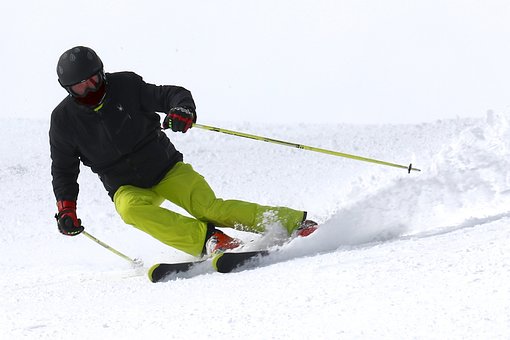
Ski, Skiing, Sport, Alpine, Race, Winter The Olympics has started, the first competitors are fighting to bring home a medal for their country and I learned something new about Alpine Skiing or downhill skiing.   If you checked out the two warmups from this past weekend, you might have learned something new.

In Alpine Skiing, ski trails are not measured by degree as many other slopes are, but are labeled in  slope percents or gradients.  The sport chose the 45 degree slope as base because the length and height is the some so when you take the change in Y divided by the change in X you get 1 or 100 percent.
 
In the United States, ski trails are rated according to one of four symbols ranging from green or the easiest to the double black diamonds indicating the most expert trails.  These break down in the following manner:

1.  Green circles indicate the trail goes down one of the  flatter slopes in the 6 to 25 percent range.

2. Blue squares represent intermediate slopes in the 25 to 40 percent range.  These trails are the most numerous and heavily used at all resorts.

3. A single or double black diamond represents a slope in the 40 and above range.

Think about this, the normal stairs that are 7 inches high and 11 inches long have an angle of 32.5 degrees but a percent slope of 63.9% which would make it an advanced slope.   The thing about Alpine skiing is that the classification of the trail is not only decided by the slope.  It takes other factors into account such as type of snow, distance and width of the trail, and bumpiness of the trail.

A trail with a percent of slope 35 percent may be considered an intermediate slope until you take into account the fact it is only 45 feet wide instead of the normal 100 to 150 feet.  It takes more skill to stay in control with the narrower track so it might be labeled advanced.

Alpine skiing is the general type of skiing done at most ski resorts.  Its the type I tried once but kind of gave up when I went down the hill backwards until I ran butt first into a tree.
 and other things.  I was also intimidated by 6 year olds who flew down the advanced track like it was nothing.

Let me know what you think.  Have a great day.


Friday, February 9, 2018

Laughter and Learning

Children, Latino, Beautiful, Innocence  The other day, I came across a title about laughter and math.   We know laughter can help a person stay healthier but can it help a person learn better?  This is one of those topics that no one ever talked about during teacher training so it sparked my curiosity.

According to the American Psychological Association, laughter can indeed help a person learn.  There is growing evidence that comedy when used appropriately, can improve student ability because it cuts down on anxiety, increases motivation and participation.

It appears that people are more likely to remember material if the professor sprinkles relevant jokes through the lecture.  In addition, well done humor inserted in recorded or digital material can motivate students into checking it regularly.

It appears that humor helps to relieve stress.  Furthermore, laughter itself can cause the body to decrease its production of specific stress hormones.  One way to help students relax during tests is to insert humorous directions or items designed to relax students so they feel less stressed. 

Another effect is that students believe they learn more from a professor who uses humor. They also feel that a professor who uses humor communicates better and are more responsive to student questions.  The things about incorporating humor into the classroom is that it has to be done so it does not distract the learning process. 

When integrating humor into the classroom, it is important to focus on learning first.  Remember, the humor is must be created with the student in mind.  It should not be overdone otherwise students look forward to the next gag, rather than focusing on the material being presented.

Furthermore, students who laugh in the classroom tend to develop good communication skills and improved critical thinking skills and creativity while deceasing the amount of stress they feel.  If they laugh in groups, their ability to work in groups improves their comradery, and helps develop a strong bond with others.

Research has shown that humor activates the brains dopamine system. The dopamine is important for the brains long term memory.  In addition, humor as stated earlier, does improve retention for students of all ages as long as it directly applies to the topic, otherwise it is not effective.

I admit, its hard for me to come up with humor for my math classes because most of us do not go around telling mathematical jokes to each other.  Never fear, a short look at the internet indicates there are quite a few sites with mathematical jokes starting with Readers Digest.  The very first joke I read there dealt with the ratio of pi and a pumpkin.  It made me grin.

You can put in simple searches such as jokes about algebra or jokes about trig so you can find some topic specific jokes.  Have fun with it and enjoy entertaining your students. Let them know you have a sense of humor.

Let me know what you think, I'd love to hear.

Thursday, February 8, 2018

Reading To Make Meaning.

Bear, Teddybear, Toy, Cuddly Toy, Teddy  I am working my way through "The Writing on the Classroom Wall" by Steve Wyborney.  I'm presenting each big idea to my students to help add a depth to their learning.  This week the idea is that reading is about making meaning.  That is  a powerful idea because we teach students to "read" the text but not to read for meaning.

Honestly, its not something I've ever thought about because most of the classes I've taken do not discuss the reader of a math text book should make meaning.

So how does a mathematics teacher help students learn to make meaning as they read?  There are several things they can do to help students learn to do it in math.

1.  Identify a short passage for students to read from the text, find a graph or data chart, or word problems.

2. Create a list of statements about the text that could be true or false, or could be open ended so as to generate discussion.

3. Introduce the topic of the text and have students read the statements before they read the text.  Ask them what they know about the topic before they read so they are activating prior knowledge and are able to predict possible answers to the statements.  See if they can make connections such as math to math, math to self, and math to the world.

4. As students read the text, they should write down support for and against each statement.  The support needs to be very specific so as to help develop their understanding of the material. 

5. Put students in pairs or small groups to discuss the evidence so they can read a consensus of whether the statements are supported or refuted.

6.  Conduct a whole class discussion to share their conclusions.  This gives students a chance to clarify their thinking or perhaps see something they missed earlier.

7. Use their conclusions to evaluate their understanding of the text.

These are the main steps in order to teach students to make meaning for any subject be it reading, science, math, or social studies.  If the middle school or high school teachers require students to follow the same process, it makes it easier for them to transfer it from one to the other.

Let me know what you think.  I'd love to hear.