 I am in Los Angeles learning more about historical, theatrical and other types of costuming. Have learned a bit about math. Will share more on Monday. Already learned about scaling up a grid pattern. Will share on Monday.
Saturday, July 28, 2018
Ratios and proportions
I am in Los Angeles learning more about historical, theatrical and other types of costuming. Have learned a bit about math. Will share more on Monday. Already learned about scaling up a grid pattern. Will share on Monday.

Friday, July 27, 2018
The Math of Eclipses.
 Tonight is the night of a lunar eclipse also known as a blood moon because the moon turns reddish. The one tonight is due to be the longest one for this century and it's happening between two solar eclipses.
I wondered what type of math is associated with lunar eclipses and I found several sites which can give students the opportunity to perform math associated with lunar eclipses.
As stated earlier, the next lunar eclipse is tonight but it cannot be seen in the United States. Math and You have an exercise where the student can find out when the next visible lunar eclipse happens in their location. There are also a few questions students need to answer based on the information they have.
This site explains how to calculate the length of a lunar eclipse. It begins with providing some background information before providing explanations and the data necessary to calculate a variety of factors involved in this type of eclipse. The nice thing, is the exercise breaks everything down and includes answers at the very end so students can check their work.
NASA even has a page providing the mathematical equations needed to calculate mathematically when lunar eclipses occur from 500 AD on to the future. Many of these equations are polynomials and could easily be graphed so students can see how the graphs look and how to find the time the eclipse happens.
Since the site also has links to the number and length of each lunar eclipse, students could easily graph the points to see if they can find how often this event occurs. From what I read, it appears most lunar eclipses occur in January and June or July but they do not usually last as long as the one tonight does.
This site explains what conditions are needed for a lunar eclipse, the view from space, and the Saros Cycle which ancient people were aware of. This is important because it shows students that just because the moon and sun get close to each other, they do not always cross paths and the way they cross determines whether you have a solar or lunar eclipse.
Sorry its so short but I took off again to Los Angles and will be home Monday night, quite late. Unfortunately, I was awake all night, got to the conference so I could set up my area since I'm on the committee. I am falling asleep as I write this.
Tomorrow and Sunday, I will have my usual warm-ups. I'm hoping to come up with something really awesome from this conference. Have a great day. Let me know what you think, I'd love to hear.
Thursday, July 26, 2018
Math and Music
 I love math but I also enjoy playing music. I usually play french horn in the local community band. I've often wondered what type of connection music has to math.
It is well known that music helps teach fractions and ratios because its a part of learning to play music. That said, no one is sure whether musical training encourages mathematical ability or mathematical skill promotes musical ability or whether the skills develop at the same time.
Although there is some research to indicate that musicians score higher on standardized tests, it cannot be stated with total certainty it applies to every one.
It has been suggested this occurs because most students learning to play instruments tend to come from a higher socioeconomic class.
Others have suggested people might have to have high cognitive processing skills necessary to drive both skills. One example is the use of executive functions which helps people adjust to the changing demands of the tasks. Executive functions are defined as the ability to plan, organize, and complete tasks.
Research has shown that having good executive functions is a good indicator of academic achievement. Playing music requires a person to determine the key signature, tempo, repeats, etc before playing while completing key and tempo changes during the piece in order to produce the music.
If you think about it, much of mathematical learning is looking for patterns, just like in music. So many pieces repeat the melody throughout a piece or in the more daring ones, the tempo changes quite rapidly from 3/4 to 4/4 and back again.
In addition, in the past music has been mathematically analyzed and created. It has been broken down into waves each at a specific frequency. Furthermore, people have noticed the relationship between numerical ratios and fixed sounds. People have also applied group theory's framework of symmetry to analyzing music.
If you think of musical transposition, inversion, and retrogression as group operations, this can shed new light on older compositions. It's been found that composers have used geometric type transformations as a device when creating music. Even those who play the music often have to transpose or translate the notes because the parts are not written in the normal key.
Such a nice interweaving of math and music. Let me know what you think, I'd love to hear. Have a great day.
Wednesday, July 25, 2018
Using Hand Gestures.
 We all know that person who cannot speak without using gestures. The gestures may be nothing more than hands moving in the air but the movement is there.
According to something I recently read, hand gestures in math help people learn.
One study done by Michigan State showed a video to 184 elementary students. In the video, the instructor showed the property of equality such as 7 + 2 + 9 = 7 + so both sides are equal.
The video was set up so the problem was shown next to the instructor. In about half the videos, she used hand gestures as she explained it. She used the left hand when discussing the left hand side of the equation and her right hand when explaining the right hand side of the equation. In the other half, she just spoke.
When they tested the students, those who had watched the videos with gestures did better on solving the problems than those without hand gestures immediately after and performed even better 24 hours later.
It is thought that the gestures help students understand the structure of the problem. It helps them see that no matter what numbers are on each side, the results are the same. The gesture of underlining the problem with your hand helps translate the concept from the numbers to the general idea which is what helps students learn better.
In addition, it is believed that students remember the gestures because when you watch someone else perform an action, it stimulates the areas in your brain that performs the action. Something that helps create better understanding.
Another study indicates that if students learn to use gestures, it helps them learn the material better. There have been previous studies which show people who spontaneously use gestures as they learn new material tend to remember it better in general.
This was supported by a study of 3rd and 4th graders who were divided up into three groups. The first group explained out loud their thinking and everything they were doing. The second group explained and used gestures while the third group used gestures only without speaking.
All three groups performed equally well when asked to do math immediately after learning the material but the big difference showed up 4 weeks later when students were retested. At this point the group who spoke and used gestures remembered 92% of what they had learned. The group who used only gestures remembered 80% but the group who used only speech remembered 33%.
This particular idea is still being researched as they are trying to figure out why using gestures work so well in helping students learn the material better. I'll keep following this one topic and see.
Let me know what you think about this topic, I'd love to hear. Have a great day.
Tuesday, July 24, 2018
Knitting, Math, and Classes
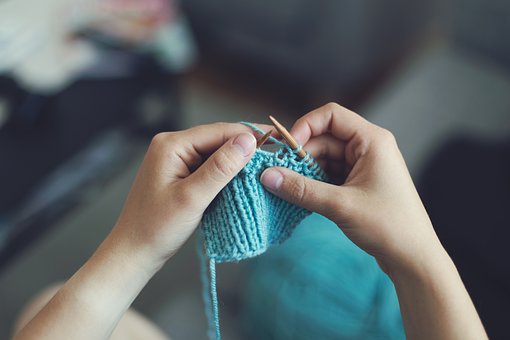 A friend sent me a link for an article dealing with a college math class whose instructor taught math in a very nontraditional way. In fact, she threw out the textbook, pencils, paper, and calculators.
Much of the math is being taught through the act of knitting while recording thoughts and answers via blog entries.
One question she posed to students involved two different pillows. One had the sides in this color order: red, yellow, green, blue, while the other has colors in this order: yellow, green, blue, and red. If you rotate the first one 90 degrees counterclockwise. The question is "How many ways could you put the pillows down on the bed to make it look different. The answer is 24 but only 8 can be found by moving one pillow. To figure out the answer, students followed instructions to create the pillows needed to physically complete the exercise and find the answer.
Another topic is Rubber Sheet Geometry in which the idea is that all polygons, if they are made of a flexible material, are actually circles. This shows up in knitting because when you knit a sock or gloves using double pointed knitting needles, you use three needles to create triangular shape yet when you are finished you have something that is actually circular.
On the other hand, if they knit an infinity scarf, this shows them an exception to the concept of creating a polygon out of a flexible enough material and the result is a perfect circle. They see it when they've finished following the directions.
In addition, there is something going on at the North Branch of the Nashville Library system to help girls use knitting to become more interested in math and science. The group meets once a week on Saturdays to knit something in response to a challenge.
The first thing the program does is to teach students to knit. Once they've learned the basics students are given a series of challenges to figure out on their own. One example of this is to knit a square made up of concentric squares of alternating colors. Another one is for them to create their own bag which requires them to use proportion and ratios.
The youngsters wear cameras around their neck to record how they solve the challenge. The visual record is then analyzed by the people running the program.
Another thing that has been discovered is that knitting often illustrates three dimensional mathematical concepts in a way that is easily understood. One professor stated that he'd over heard two college students discussing analytic geometry only to find out they were discussing how to knit an argyle sock.
That is a cool way to teach mathematics but at the moment, I don't think it will take off the way it might because many schools seem to believe that math still needs to be taught in the traditional ways. Let me know what you think, I'd love to hear.
Monday, July 23, 2018
The Cost of Reality TV.
 I discovered my Amazon Prime includes a few interesting reality shows. The ones I love are the cooking competitions. Over the past few days, I've been watching tons of the shows. I am addicted to them.
 In addition, many cable channels are moving from regular fiction shows to "Reality" or non-fiction television because people are attracted to these.
I've heard Reality shows are cheaper to produce than the usual scripted ones such as NCIS or Hawaii-5-0.
Lets start with a few stats on reality television before we look at the cost. In 2001, these types of shows accounted for 20% of prime time programming. It jumped to 40% in 2013 on average but for some stations reality television accounts for 90% of their programming. In the 2012-2013 year, four of the top ten and eight of the top twenty-five top rated prime time shows were reality shows.
Due to the low production costs, the profit margins can be so much larger than with scripted shows. Several cable station's for profit margin (those with reality programming)
1. TLC with 60%
2. The Discovery Network with 58%
3. National Geographic with 52%
4. Investigation Discovery with 35%
The average cost for a reality show is between $100,000 and $500,000 which can be so much less than a scripted show. To show the difference, Royal Pains, a scripted show, runs between $2 and $2.5 million per episode. One reason reality shows cost less is because they use fewer writers and employees but the cost can be made up in paying the 'talent' hired for the show. For instance, Sarah Palin wanted to be paid $1,000,000 per episode for her reality show. That is the same amount James Gandolfini received his final year of the Sopranos show.
On the other hand, the girls in "Jersey Shore" a reality show, only received a few hundred per episode and eventually were paid $10,000 per episode as compared to Charlie Sheen in 2009 who earned over $850,000 per episode in Two and A Half Men.
Furthermore, these reality shows allow smaller or emerging cable stations can produce a full season for between one and three million because everything can be shot in one day. If its a bigger network with more complex shows, which can cost quite a bit more. For instance, one episode of Survivor can cost $2,000,000 per episode or a price of $30 million for the whole 15 episode season. Each episode of Survivor takes 3 days to shoot with a pre and post production which runs most of the year.
Although I looked for math activities created to use information on the cost of reality television, I was unable to find any. I wanted to share some of the differences between scripted and reality shows so you can share it with your students. If you have ideas other than creating graphs or figuring out the difference in cost as a percentage, I'd love to know.
Much of the information come from this paper. I found that one of the pie charts on page 12 had percentages that add up to more than 100% so there is a mistake. This is the perfect opportunity to have them read the graphs and figure out what is wrong with it.
Let me know what you think. I'd love ot hear.
Sunday, July 22, 2018

Subscribe to:
Posts (Atom)