Wednesday, August 8, 2018

Imaginary? Really?

Symbols, Square, Number, MathAt some point we teach students about imaginary numbers.  We define it as the square root of -1.  We show how the pattern repeats every four times it used but are we ever able to provide students with a real situation.  I've been told it is used in electronics but I really have no idea how so I went on the internet to find the answer to this question for the next time I have to teach it.

i is considered an imaginary number,  one used for finding roots of negative numbers, quadratics, etc. 

One reason I didn't realize imaginary numbers appear in electronics is because they use the letter j instead to denote the same thing because i refers to current.  It is primarily found with alternating current which changes from positive to negative sine ways.  Being able to use both real and imaginary numbers help combine alternating currant without being electrocuted.

Imaginary numbers can help describe the movement of shock absorbers in cars as they go over speed bumps, or in modeling how fluids travel around objects in their way, analyzing economic systems and structures using riveted beams, modeling light or water waves, and so many other applications.  Usually, the use of imaginary numbers occurs more frequently in higher level maths.

In addition, you will find imaginary numbers used in signal processing, cellular technology, wireless technology, biology, and radar.  Furthermore, the imaginary number has made an appearance in fictional literature such as The Da Vinci code and The Imaginary by Isaac Asimov where the imaginary number helps describe the behavior of a certain species of squid.

So now when my students ask me about the real life uses of imaginary numbers, I will have an answer.  Let me know what you think, I'd love to hear.  Have a great day.


Tuesday, August 7, 2018

Math and The Fashion Designer.

Catwalk, Models, Women, Fashion . Inevitably. there are one or two students in every school who dream of designing clothing and starting their own line.  I remember a girl I went to school with who created and sewed her own stuff.  She had talent but most kids now who want to design clothing, know little about the math involved in it.

I came across a presentation or two dealing with this topic when researching the math of pattern making. 

This slide share presentation has some great information and activities.  This packet covers the cost of making the piece so they know how to do it and how to calculate profit, patterns and material, sketching the design using various geometric shapes, parallel and perpendicular lines, symmetry and congruence, types of tessellations, creating prototypes, measuring, fractions, the fashion show itself and refreshments, filling orders from the show by making clothing, and the cost of tailors who make the clothing.  Everything from start to finish and it does include the answers.

This entry is done by a fashion designer explaining how she uses math in her field.  She explains you have to know where measurements are taking you can provide the measurements at the waist, neck, back, etc so someone can make the sample garment, then add or subtract from the sample garment so it fits well.  In addition, designers have to know geometry well so they can create flat pattern pieces which when sewn together make a 3 dimensional garment as well as knowing where to make changes in the pattern piece if needed.

So these two entries show there is math from start to finish.  Think about it.  A designer takes a flat one dimensional drawing, usually one for the front, one for the back and possibly a side view, scales it up to a finished product while determining the shape and size of each piece, creating the pattern, making it and fitting it.

It is not an easy thing to do.  I am not a designer but I can take a historical drawing and create the pattern pieces for it because I know how they used to put together things.  They do things differently today such as in the 1870's a sleeve was usually made out of two pieces to create the correct look but now they use one piece.

I'm off.  I hope you liked this.  Please let me know what you think, I'd love to hear.

Monday, August 6, 2018

Sorry

Due to new computers not being available till today and the local internet provider having problems getting my home internet up and running, I have been without any till today.  I will be back to normal tomorrow.  Thank you for your understanding.

Thursday, August 2, 2018

Airline Mles

Virgin, Airline, Sky, Flight, Air  I have been doing so much travel this summer that I wondered about air miles and the various plans.  The airline I use as much as possible guarantees a minimum number of miles for any trip, adds bonus miles, gives miles when you use their credit card and the miles never expire.

I know not every airline is like that.  So I was thinking that having students compare various plans from an assortment of airlines both American and International would make a wonderful project.

I know that some airlines have an expiration on mileage while others charge more miles to travel.  I've used some of my miles in an emergency when my sister died, so I could see her before she passed and I needed to get family members to the funeral.  Other times, I've used miles to get someone to a city where the connecting flight began because it was cheaper.

But what restrictions exist with other airlines in regard to using miles?  How many points do you get when you travel?  Do you get more if you pay for a first class ticket rather than being upgraded?  Do you get more points based on the class of the ticket?  I discovered when I traveled on a partner airlines, the class determined how many miles I got.  I ended up with 75% going over but 50% coming back because of the different class. 

When I traveled another partner airline, I got all the miles both ways.  Something to check up on. See how many partner airlines you have access to and what their rules are on miles.  Sometimes, you are not sure until you have traveled.

So this leads to a wonderful project where students investigate the mileage plans of various airlines, check out their partners, find out how many miles are needed to travel to certain places both coach and first class. 

The information can be prepared as a written report as if they were reporting back to their employers on the topic.  The report can include things like graphs comparing the minimum amount of miles needed to travel certain places, miles earned, etc.

Many people are not aware of how their mileage plans work.  Let me know what you think, I'd love to hear.

Wednesday, August 1, 2018

E-Books and Math

Coffee, Book, Flowers, Setting, Romantic I purchase e-books because I do not have space any more for the hard copy books.  I still order some so I really need to go through some of the books I have now to get rid of so I'll have space for those.

On the first of the month, Amazon always posts the new books for the monthly deal where instead of paying $12.99, you only pay 2.99.

The other thing is that Amazon lists the pages for each book they sell in digital form.  The page number might be at the end of the description or it might be at the bottom in the part that tells you how big the book in electronic size.

Its important to check the size of the book you are buying because if you are like me, you really do not want to spend $5.99 for a 28 page book.  Don't look like that!  I've seen cases like that.  Or $2.99 for a book that's 287 pages long.

I seldom buy a book that has less than 100 pages unless its a very specialized book and I try not to spend over about $6.00 per book because I feel a digital book should cost less than the print copy not the same or more.  A digital book is so much easier to publish, requires nothing in terms of actual printing, and takes less to produce.

There are several math opportunities available a math teacher could implement in the classroom on digital books.

1.  Create a list of books on sale such has those on the monthly deals list at Amazon.  Have students check every book for the print price, original digital price, and the sale digital price.  Students can analyze to determine the percent difference from the print to original digital price is.  They can then determine the percent mark down from the original to sale price of the digital version.

2.  Create a list of digital books on a topic.  Have students look at the number of pages for each ebook.  Have them justify which books they would purchase and why.  One time, I projected the description of two different digital books on toilet training your cat on the board.  We talked about the prices, I think one was $4.99 for a 15 page book while the other was $2.99 for 32 pages.  I asked which one they might buy and why.  I accepted neither as an answer as long as they could justify it.

3. In addition, students can compare the prices of one book in digital form, hardback, paperback, in used and new versions.   The reason behind this, is many used books may be way less but by the time you've added shipping into the cost, the used version is not any cheaper.  Students can create a list of prices for used books broken down by condition before turning the information into various graphs. 

Its important for students to learn to do comparisons based on real world data.  I find the digital world interesting because anyone can publish books now.  In addition, many authors price their digital version higher than the hard copy version.  That I do not understand but it happens and the technical books tend to be more expensive in digital form, just like they are in hard copy.  You might want to let students check it out themselves and then make suggestions on why this happens.

I did take a break from fashion because it is the first of the month.  I'll get back to fashion math in a day or two.  I am getting ready to head back to work so I get distracted.  Have a great day and let me know what  you think.

Tuesday, July 31, 2018

Pattern Making

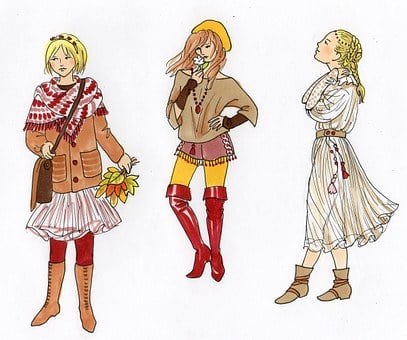
Fashion, Fall Fashion, Clothing, Woman I have friends who work at FIDM which is the Fashion Institute in downtown Los Angeles, California.  This is where future fashion designers among others come to learn their trade. 

One thing they often comment on is that they've seen project runway or some other show and they want to be a fashion designer.

The issue is, they don't know how to sew, iron, or even cut a commercial pattern out. To be a fashion designer, especially if you are just starting out,  you need to be able to create the drawings before making the patterns.

To translate a drawing such as above into the pattern used to sew the final product, the process involves a certain amount of math. Creating patterns is sort of like looking at one of those complex shapes you have to find the area of, break it down into individual shapes before calculating the are for each shape.

 With patterns you have to take the drawing, break it down into pieces before figuring out the particular shapes needed to create the piece.  In other words, a student has to use critical thinking skills combined with problem solving to do this.

In addition, a pattern maker has to calculate the way the measurements are distributed in the pattern. For instance if the pattern needs to be made for a 36 inch bust, 27 inch waist, and 35 inch hips, the pattern maker needs to remember that the 36 inches does not divide equally into 18 and 18 because most women have a bit more in front so the back might be 15 inches across and 21 inches in the front.

Does the final outfit need to be fitted or is it loose.  If it's fitted, you might need to include fitted darts but do you need one from the bottom or one from the bottom and one from the side to make the bust fit better?  Most skirts if they are fitted have at least two darts in the front and two in the back.  Placement and depth of those are important.

What about the neckline?  If the neckline is a V-neck, the pattern maker needs to make sure the angle is correct, otherwise it won't look right.  If its a scoop neck line, the circular arc has to be proper or it won't hang right.  Practical applications of the use of angles and degrees.

After drawing the basic pattern, the pattern maker needs to make sure they include a seam allowance which is usually 1/2 to 5/8 in.  Commercial patterns have 5/8 usually while specialty designs are 1/2 inch. 

A pattern maker has to be good at math, including fractions because many measurements are like 25 3/4 or 32 1/2.  You might have to dive the fraction by 2 or 4 so you have to be comfortable using math.

Lots of math.  Tomorrow, I'll look at the math a fashion designer needs for a project from start to finish.  Let me know what you think, I'd love to hear.

Monday, July 30, 2018

Grid Patterns and Ratios

Fashion, Lady, Card, Tag, Woman, DrawingWhen I am not teaching math, I make costumes from scratch.  I also buy parts and put them together to create a certain look.  It all depends.  I was at Costume College this past week which is a three day event where people come to learn more about certain aspects of costuming.  They sometimes listen to lectures while other times, they attend workshops.

One lecture I attended was on enlarging pattern pieces drawn on graph paper in books.  Many times, the books are published showing a style like the one in today's picture.  On the other side of the page they print the pattern pieces. 

Sometimes, the pieces are separated while other times the pieces are printed on top of each other.  Either way, they are printed on a grid with a scale found somewhere on the page.  Occasionally, you will not be able to find a scale so you set one such as one square equals one foot.  Some of the earlier books do not even have a scale and you end up reproducing it on graph paper.

The instructor suggested people stock up on wrapping paper because the backside of it has one inch squares already printed there.  To do this, she taped a good sized sheet of paper on the board so it would remain stationary.  She would then place a dot on one intersection that represented the corner of the piece.

From there she would carefully count out from there the number of squares to the left, or right, up or down.  If there were curves, she'd carefully  mark off the appropriate dots and connect them using a french curve.  Eventually you end up with a larger pattern that has been proportionally enlarged properly.

Most people who start with these types of patterns, realize the enlarged pattern will probably not be the correct size even enlarged.  This is for several reasons.  One is that if the piece the author used was old enough to create the pattern, it could have been a young person's outfit so it will be too small.

Little history lesson here.  Way back in past times, especially in the 1800's once fashion and women's magazines started appearing, small patterns on grids were included in as a special extra.  Many magazines would publish one outfit a year, or every quarter or every issue depending.  Women were expected to take the small sized drawings and create the full sized patterns to make the outfit.

This is a wonderful example of how ratios and proportions are used in real life.

  Several of these dresses might have been made by enlarging a pattern from a book filled with patterns from a certain time period.  I've done it but I didn't use this method. 

Let me know what you think, I'd love to hear.  I'm still researching the mathematical pattern information for clothing patterns.  As soon as I find it all, I will be sharing.  Have a great day and sorry I went MIA for Sunday but I got so caught up in attending classes, I didn't get a chance to post anything.