Thursday, February 7, 2019

Comparing and Contrasting in Math.

Mindsets, Experiences, Gender  There are so many times I let an opportunity pass by for students to compare and contrast in Math.  They see this exercise as one you only use in English class but it is one that works well in Math.

Compare and contrast offers so many advantages to math students in terms of learning the topic. This technique helps develop higher order thinking skills, improves their memory of the material, it improves their understanding, helps them organize new material, and it helps develop their minds.  

Currently, I am using this in Geometry.  I have students doing four different compare and contrasts with the notes they took on five quadrilaterals.  I've asked them to do one for rhombus and squares, kites and trapezoids, rectangles and squares and rectangles and trapezoids.

They are finding it challenging because they prefer to just copy notes into their notebooks rather than trying to make sense of the notes.  I like the way its working out because it is making students talk to each other as they work in groups trying to find all the similarities and differences between each set of figures.

This is not the only place compare and contrast can be used.  I've discovered several other ways which can be used in different levels of high school and middle schools.

1.  Compare and contrast long division and synthetic division.

2.  Compare and contrast different ways of multiplying binomials.

3.  Compare and contract GCF's and LCM's.

4. Compare and contrast regular fractions and algebraic fractions.

5. Compare and contrast decimals with place value.

6.  Compare and contrast student methods used to solve a problem.

7. Compare and contrast the ways to solve systems of equations.

8. Compare and contrast solving systems of equations and matrix.

There are so many other possibilities for using comparison and contrast in the math class.   Let me know what you think, I'd love to hear.  Have a great day.

Wednesday, February 6, 2019

Yahtzee and Math

Yahtzee, Cube, Pencil, Craps, PlayComputer based testing just started and that means that only the computers in the Library and Computer lab are allowed to be used.  All other computers and digital devices cannot so I have to plan alternative activities for my computer based credit recover class.

Most of the students in that class have tried the regular classroom but cannot hack it so they are here.  Some are trying to make it while others don't do much.  So I have to prepare lessons for students as if its a regular class.

So on Tuesday, I had to do something that didn't involve a computer.  I printed off two worksheets to practice order of operations and two of the three who made it, did quite well.  They listened to me, they worked through the problems doing it step by step until the sheet was completed. 

Rather than have them do another worksheet, I broke out the Yahtzee game for them to play.  I figured it would strengthen their adding and multiplication skills, have them predict what they needed to get a small or large straight, full house, or other combination.  The boys helped each other, discussed what would be better for the other to aim for and had a good time communicating.

Later in the week, I think I'll teach a probability lesson using Yahtzee and dice.  I found this activity which has pairs of students roll two dice until they each roll a six on one die.  They have to write down the numbers they rolled each roll and the number of rolls they made.  On the whiteboard, students will write down the total number of rolls it took to get the six.  At this point, have the class calculate the average number of rolls to get a six.  It should be about 6 rolls.

Repeat the experiment, only have each student roll both dice to see how long it takes to roll two sixes at once.  They need to write down the combination each time the dice are rolled and keep track of the roll it is.  Have students write the total number of rolls it took to get double sixes on the board.  Once all the data is on, they need to find the average of rolls which should be around 36. 

At this point, its time to have a discussion with the students to see if they can figure out the mathematical probability of rolling a six with one die (1/6) and the probability of rolling double sixes (1/36 or 1/6 * 1/6).  Its possible to take this even further.  If you want to know all the probabilities for three of a kind, four of a kind, a full house, etc check here because they have the probabilities with explanations and graphs.

Speaking of graphs, one can take the number of rolls and arrangement of the die or dice and create a histographs or other graph from the completed data collection.  I am going to try this later in the week and we'll see how it goes.  Let me know what you think, I'd love to hear.  have a great day.

Tuesday, February 5, 2019

Using Origami to Teach Math.

Origami, Paper, Folding, ArtisticOrigami is so much easier to include in classes since people have created apps that show step by step how to fold different animals, and objects. In the past, I've given students my iPad with an app on it, the paper and let them loose. There is usually one student who takes the lead and instructs everyone else step by step until the item is completed. 

Origami in and of itself teaches the following skills.

1.  When making a fish, or other origami item, a student has to follow directions in the proper order to get the final product.

2. The directions involve manipulation of paper spatially  because the final product is three dimensional and if the paper is not folded properly,  with regard to its spatial position, it may not come out correctly.

3. Many of the origami figures begin the same way but it is the way it is finished that determines the final product.  So the origami offers variations from one basic set of instructions, much like many mathematical procedures are based off a set of instructions which can be applied to different situations with a bit of adjustment.

4. Origami is made by following a set of directions which forms the basis of communications.  If the directions are not communicated well, the student might not be able to finish it properly.  The young lady who took the lead in my class communicated the directions to everyone else so they'd get the correct finished product.

5. It is also student centered, requires cooperation as students work together to follow directions, and its a form of applied mathematics.

Origami is one of those fun activities where you can divide the students into several groups.  Each group is giving one figure to learn to create so later in the class, students go to other groups to teach others to create the same figure.  This allows students to practice communications and vocabulary because its easy to incorporate geometric vocabulary into the activity in addition to general vocabulary.

Furthermore, you can have students create directions for the origami figure they learned so others can attempt to follow these directions.  The directions should include both words and diagrams.  This gives them a chance to work on communications.

Other things you can do is have students identify types of angles, types of triangles, or geometric shapes they see as they are folding their creation.  This helps them see geometry is a part of origami and their knowledge is transferable.

So if you want to incorporate origami into your mathematics course, you now have the justification to use it.  Let me know what you think, I'd love to hear.  Have a great day.


Monday, February 4, 2019

Pattern Block Use In MIddle School and HIgh School Math.

Mosaic, Texture, Coloured Stone, Tiles Every school I've taught at, my math room has had a set of pattern blocks. The science teacher just borrowed my set because she wants to work with the 9th graders learn to graph and these blocks offer an easy opportunity.

One way to do this is to hand students a handful of pattern pieces which they sort and note the number of each type of block.  Using the data they are able to create a bar graph. 

In addition, pattern pieces can be used in geometry to help students name the shapes, find the equation for area and for perimeter.  The pieces can also be used to practice finding lines of symmetry.  You can also have students use certain pieces to create squares, parallelograms,  pentagons, etc instead of using tangrams.

Of course, pattern pieces can be used to illustrate fractions because the pieces are set up so students can see that the rhombus is 1/3rd of a hexagon, a triangle is 1/6 of a hexagon, while a trapezoid is 1/2 of a hexagon.   Furthermore, students can determine how many triangles in a rhombus or the number of  triangles in a trapezoid.  It gives students the chance to understand that fractions are not always slices of pizza, either circular or square. 

Students can use pattern blocks to create their own version of which one does not belong or odd man out so that one is different. Rather than having the teacher set them up, let students do it because it allows them to develop critical thinking skills to look deeper than just color or length of sides.

Another activity for students is to create clues so a person can place the shapes in the correct order from one to four.  The clues might be "The shape with four equal sides but with no 90 degree angles is in space 3. This activity helps students think logically.

Furthermore, pattern blocks placed on a coordinate plane can be used to help students learn about transformations such as translations, rotation, and symmetry.  Students can mark the points of a pieces vertex in the original place and the new place, then discuss the translation in terms of unit and direction.  Rotation and symmetry would work the same way.

These are just a few ways pattern blocks can be used in middle school or high school.  Let me know what you think, I'd love to hear.  Have a great dayl.

Friday, February 1, 2019

The Importance of Mathematics.

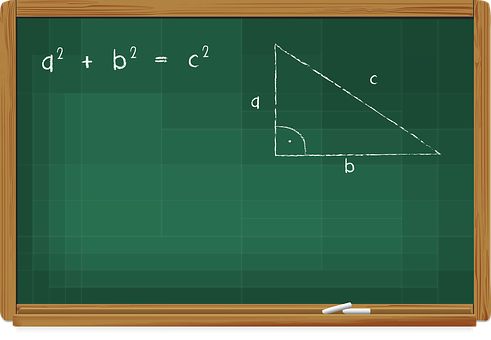
Blackboard, Teaching, Chalk  I love challenging my students when they tell me there is no real reason to learn math because they'll never use it.  I ask them to name one profession that does not use math.

I'd get guesses from rock star to grave digger.  For every job, I'd point out the math needed.  I pointed out to the guy who wanted to be a rock star that he needed to know math so he could make sure his manager was not ripping him off.  To the grave digger suggestion, I pointed out that graves had to be dug to a certain depth, have a certain length and width so the coffins could fit in.  One young person finally commented that he thought the only way you could escape math was to be dead.

There are so many reasons one needs math in life.  Its been found that high school students who take demanding classes in high school including math courses beyond Algebra II had a much better chance of graduating from college.

In addition, math is good for the development of the brain.  Certain studies indicate that students who know math are able to access certain areas of the brain more reliably and those areas have more gray matter.  These same areas appear to be associated with decision making and visual attention.

Although digital time pieces are on the rise, there are still quite a few analog clocks around.  My school is filled with them but studies have found that more and more children are unable to read the time on analog clocks.  Analog clocks use fractions as part of the process of reading them because you have quarter hours, half hours, and whole hours.

Unfortunately with the rise of credit card use, so many students do not get the opportunity to learn about finances. They don't know the math involved in paying down or paying off a credit card, versus the deposits made into a bank account.  They don't know how to plan a budget, figure out how much they've spent on things, etc.  Last semester, several students took a basic finance class which included students learning to balance a check book with deposits, service charges, etc and they struggled because most come from homes where people cash checks as soon as they get them and use cash around the village.

On the other hand, if you know math, you can expand or cut recipes easily so the final product turns out well. Its not easy for many students to half or double 1 2/3 cup or 1 tblsp.   In addition, math helps us with problem solving because it helps us learn to think analytically and improves our reasoning.  All those "stupid" word problems (I'm quoting my kids) actually do help people identify known and unknown while applying strategies to solving problems or situations.

As stated above, you'll find math in every job out there from stocking shelves, calculating taxes, to commission, to everything.  There are jobs out there that require people to take basic math tests and certain long term care insurance policies that test you on your mathematical ability as part of testing prospective insurees.

In addition, when NASA launched space craft to outer space looking for life, the language they chose was mathematics because it's considered a universal language.  After all, the process and written format is the same no matter the language spoken.

Its always nice to explain why math is important to students who only see it as drudgery.  Let me know what you think, I'd love to hear.