
Thursday, February 14, 2019

Wednesday, February 13, 2019
Improving Questioning in the Math Class
 As a teacher, its easy to get in the habit of answering all student questions rather than taking time to determine if answering the question is the best solution. I need to take time to think about the question being asked and my response. I'm going to share something I discovered in regard to questions and answering them.
Let's look at the questions so many students love asking the teacher. "Is this right?" In a way its asking for immediate feedback but it also means that many students rely on the teacher's response rather than checking the answer themselves. It is quite possible they rely too much on the teacher responding and not enough on learning the process or concept themselves.
When a child asks this, it might be better to respond with "Are you sure?" weather its right or wrong. At first students may panic but they will eventually get used to it and might start responding with their thinking. This can lead to the next question of "How do you know?". This question requires them to explain their thinking. Often as they state their logic out loud, mistakes will become obvious and they can fix it.
If you write two equations on the board, then ask "What do you notice?" it gives students a chance to comment on similarities, differences, and helps build understanding of variations in procedures in addition to assessing their understanding. If students have limited English, you might ask "What's the same?" or "What's different?" which is a more specific set of directions.
Another way of making students think is to have them convince you of something such as all multiples of 8 are multiples of 16 or taking a square root is the opposite of squaring a number. This activity helps students develop generalization of mathematical ideas. You could also ask students if there is another way to work a problem because it shows students there is more than one way to do a problem. It also allows them to see they don't have to do it like everyone else.
If you want to improve generalizations, help develop reasoning skills, or deepen understanding, ask questions that are NEVER, SOMETIMES or ALWAYS True. A question like "Is it always, never, or sometimes true that the four angles in a quadrilateral add up to 360? This makes them think about all situations before answering.
These are a few ways to make questioning more effective in the classroom. Let me know what you think, I'd love to hear. Have a great day.
Tuesday, February 12, 2019
4 Ways to Make Math Class More Interesting.
 One thing about math, is that students often arrive to class saying "They hate math." or "They aren't good at math" and some have already given up, convinced they can't do it. One way to help them get past that attitude is to make class more interesting. If you can capture their interest, they are willing to work.
One way is to create a hook to real them in much like a fisherman who uses a fly or bait that all fish find attractive. "Teach Like A Pirate" by Dave Burgess has a book filled with tons of suggestions for creating hooks to grab student attention. I've used some of the suggestions to create ones for math.
Another way is to relate the math being taught to student's hobbies or interests. For instance, relate discounts to shopping because most people are into saving money as often as possible. Or surface area to buying paint and tiles for redecorating a bedroom. I've assigned a project in the past where students designed their dream bedrooms complete with movie theaters, basketball courts, swimming pools etc and then they calculated how much it would cost to finish it using a list of prices I provided. Students loved this one because they loved the idea of making their bedroom the size of the classroom or bigger.
Of course, as the teacher you can change up the order in which class is taught. Instead of lecturing right after the warm-up, do some sort of activity that allows them to explore the current topic before the lecture. Throw in a game to stir things up. That way, they don't get stuck in a routine of same old same old.
Another suggestion is to give students a choice on how they will show they've learned the material. Will you let your rapper create a rap on the different types of quadrilaterals? Let the video guy make a movie of how linear equations are used in real life? Will the budding classic musician be allowed to explain the time signatures in terms of mathematics?
If students are given choices, make sure the choices stays true to the goal of the lesson. All choices must have the same end goal. Before giving students the list of choices, its important to make sure they have a good understanding of the topic and its concepts. When setting up choices, the choices should all be rigorous and you should know how long each option will take. They should all take about the same amount of time.
Choice can be offered via a menu, a choice board, a Think tac toe board. If you wanted to offer something a bit different, off students the option of making a game of some sort to practice the topic when played.
Have fun. Let me know what you think, I'd love to hear.
Monday, February 11, 2019
Change in Plans
 Due to the limited bandwidth at the school, we've had to discontinue all computer based programs which is making it challenging. As a result, the department heads had to figure out how the alternative students will finish their classes.
The majority of these kids are there because they have difficulty in regular class and honestly, the majority of them have not been doing well with these computer based classes.
As a response, we've put together units which we hope students will find interesting. The majority of students taking math were enrolled in a 6th or 7th grade math. I believe the idea was for them to get through a math class so they could graduate but few have finished more than 5% of the class.
Most of the teachers are hoping students will do better if they can choose what they want to study. I spent Saturday putting four different units together for 15 students. The units only contain the first week of work but I have more to organize for the next two to three weeks.
One unit covers aviation math which will look at simple vectors, converting C to F, calculating distance, speed, and time, calculating amount of fuel needed, ground speed, take off and landing, and a few other topics. The first week has them reading a general introduction to the topic so they have a better idea of what the math is for each item. They will do a worksheet on vectors, converting C to F, and calculating airspeed.
Another unit is on carpentry math. The first assignment is focused on learning about angles, Pythagorean theorem, and roof angles. There are four reading assignments with problems, and identifying angles as right, acute, or obtuse. Carpentry is a skill they can use out here in the village so its something they might be interested in.
Of course, I threw in a Cryptography Unit because I think its fun. They begin by working some simple codes using the Caesar shift. The next activity explores this shift in even more detail followed by the reading and trying to work a worksheet introducing each type of common cipher. Each week, they'll do more coding and breaking codes while learning about various codes in detail.
The final unit is on Forensic Math. For the first week, they will use ratios to calculate a perpetrators height based on their foot length and they have to identify if the person walked, jogged, or ran away. The last assignment will deal with bullet trajectory. Next week they will be introduced to the math of blood splatter. Over the next few weeks, they'll calculate how long since the person died, learn more about calculating height from the bones, and if the victim is male or female etc.
The hope is that these students will do more math if it is not taught in the traditional way and if its something that will peak their interest. The science teacher is offering a forensic unit from a science point of view which is why I chose to look at the math. We are hoping students might get interested and do the work.
I'd love to get feedback from people on this idea. These students don't work in regular class. They are absent or late to class to much and only seem to come to school for the socialization. We hope this sparks their desire to work. Have a great day.
Sunday, February 10, 2019

Saturday, February 9, 2019

Friday, February 8, 2019
No! NoTo Timed Tests!
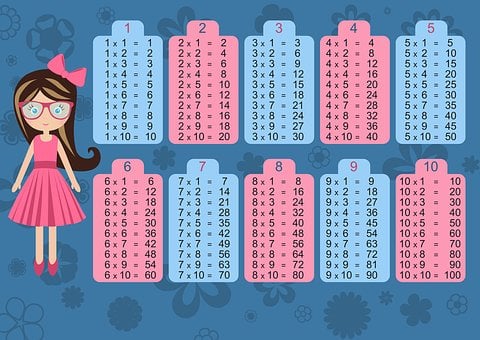 The other day, our principal gave his report on the workshops he attended at the last RTI conference. In one breath he told us he'd been told that its not good to do timed multiplication drill tests and then said we need to use those to teach the kids their tables.
Unfortunately, the belief exists, the faster a student is at completing their addition or multiplication tables, the better they are. It sends the message that faster means you are more intelligent but that is not always true.
I've seen it manifest itself in high school to the point that students race to finish an assignment as fast as they can but they don't take the care to make sure their work is correctly done. When these students finish their assignment in the shortest amount of time, it makes others feel as if they are not good in mathematics even though they make fewer mistakes.
The other day I gave my Algebra II class a test. The first two tests were turned in well before the period ended. I glanced at the tests, promptly handing them back before telling those students they needed to check their work because I'd seen quite a few mistakes. These students checked their work and found several errors but I've had other students tell me their work was fine and they didn't need to check it.
There is concern that timing these types of test may create anxiety in the person taking it which in turn can cause them to forget the facts they've already learned. Furthermore, this type of testing may interfere with their learning and it does not necessarily give a true picture of who knows their facts. Some students love competition and want to be the first done but that is not true of everyone. Those students who are not competitive may know all their facts but are unable to answer problems in this situation.
There is some evidence out there indicating that timed fact fluency tests may actually cause students to learn their facts slower. create a life long anxiety and make it harder for them in the future. The ability to do your facts in under one minute does not indicate a person can apply the knowledge in other situations.
There are other ways to test for fluency without involving timing. One way might be to "interview" students by asking them what "5 x 6" mean? "What is the answer to 5 x 6?" "How did you find the answer to 5 x 6?" "Could you have found the answer another way?" "If your friend has trouble remembering this, what might you suggest to help them learn the fact?" Another way might be to ask them things like "Can you use 3 x 8 to help find the answer to 6 x 8?
These questions require more thought to answer and they require more understanding of the concept. Timed test are great for checking for rote but they do not check for understanding and comprehension of the multiplication. I believe it is important to know the facts but you also have to know what they mean and how to use them. I am working on my students to improve their fact fluency through games etc rather than using timed fact fluency tests.
Let me know what you think, I'd love to hear. Have a great day.
Subscribe to:
Posts (Atom)