Friday, September 6, 2019

Warm-up

Dogs, Dog, Two, Forest, Sitting, TreesTree-White Linge, Butterflies

Bald, Eagles, Flying, Birds, LandingItaly, Waterfalls, Cascade, Cascading

How are these the same? How are they different?

Ratio in Cooking.

Kitchen, Work, Restaurant, Cook, ChefWhen we talk about fractions, we always seem to talk about cooking because most recipes have measurements in fractions such as 1/2 cup, 1/4 cup or 1 1/2 cups but not always.  It is said one way for people to become great cooks is to use ratios rather than standard recipes.

Many types of food are set up so that only the main ingredients are counted in the ratio set up.  Smaller things like salt, pepper, etc are not counted.  For cooking the ratios are preset proportions of ingredients so the results are always consistent.

Furthermore, since the basic ratios make up the recipe it is still possible to adjust them to individualize them by adding a bit of spice, flavoring, etc.  There is even a cookbook dedicated to teaching people about every major ratio used in cooking.

Some of the standard ratios used cover everything from bread, to vinaigrette, to crepes, to cookies. The ratios are general but they hold consistent as long as the units are the same.  If you have a 3 to 1 ratio, it will be the same using cups - 3 cups to 1 cup, or 3 cans to 1 can, or 3 tablespoons to 1 tablespoon.  It all depends on how much you want to make.

 1. Vinaigrette or salad dressing uses a ratio of 3:1 or three parts oil to one part water.  Then you add any flavorings you want such as herbs, mustard, or even spices to individualize it.

2. Brines are 20:1 or 20 parts water to one part salt.  This brine can be used for meat, poultry, or pork.  It's when they add herbs, etc that it makes it more personalized.

3. Basic soup stock is 3:1 or 3 parts water to one part bone.  Throw the bone in the water, add your onion, carrots, etc and cook.  One word of advice, weigh the bone so you can get the correct amount of water.  3 ounces of water to one ounce of bone.

4. Pie Crust is a 3:2:1 or three parts flour to two parts fat to one part water to make the perfect pie crust.  Always make sure the fat is super cold so it blends properly with the flour.

5. Bread is 5:3 or five parts flour to three parts liquid with a bit of yeast or baking powder to make it rise.  They don't count the salt used for flavoring or the bit of sugar to feed the yeast.  It also doesn't count the herbs, spices, raisins, or nuts used to add character to the recipe.

6. Pasta uses a 3:2 ratio or three parts flour to two parts eggs so this ratio requires both the flour and eggs be weighed to get the proper ratio.

7. Crepes require a 1:1:0.5 ratio or one part egg, one part liquid and half a part of flour.  The type of flour can change but the ratios remain the same.

8 Pancakes use a 2:2:1:0.5 ratio or two parts flour, two parts liquid, one part egg and half a part fat.  So the ratio are a bit different than the one used in crepes.

9. Biscuits are a 3:1:2 ratio or three parts flour, one part fat, and two parts liquid. This will give you those wonderful flakey biscuits. Again, they do not count the salt or flavorings to personalize these.

These are just a few basic ratios for making everyday things.  A quick search of the internet will pull up additional ratios used for cooking.  This is a great place for using real life ratios.  Let me know what you think, I'd love to hear.  Have a great day.


Thursday, September 5, 2019

Why Incorporate Movement Into the Classroom?

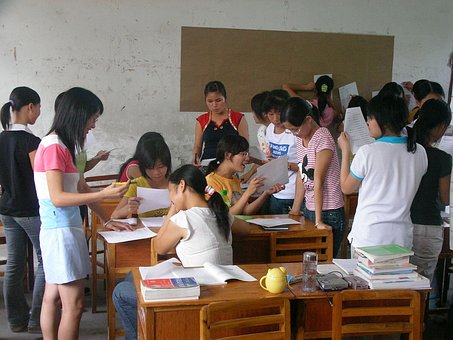
Class, Discussion, Girls, Study, ChildSince the school year started, I've been trying to incorporate more movement into the classroom because research indicates that students who move around have better focus, increased cognitive processing, and better memory retention than those who sit still all day long.

Furthermore, movement also increases the amount of blood flowing to the brain, which improves mental clarity.  It has been noticed that due to the high usage of mobile devices, student attention span has decreased. In addition schools are cutting back on recess and P.E. time are being scaled back due to budget cuts.

It is agreed by experts that students need at least 60 minutes of movement per day and by incorporating activities needing movement, this helps students get that.  The movement gives students a chance to work off stress.  Many students find learning stressful, especially if they do not have a good foundation. It can also make the class more interesting and enjoyable. By the time, students reach high school, its harder to find activities which will get them moving around.

I've read about using the four corners instead of a written multiple choice exercise.  Let students work a problem, then they choose the appropriately lettered corner to show their answer. My experience with this is if it is used with students who do not perform as well, they are likely to choose the corner the person they think does the best chooses.  They are unwilling to stand apart but in a classroom with students who are more sure of themselves it works.

I've used a scavenger hunt with students that goes well.  I take a several sheets of 8 1/2 by 11 inch paper and cut each into two pieces.  I fold each piece in half in preparation for the work.  On the outside, I place a letter in the lower right hand corner.  Then I write either problems or vocabulary on the outside, one per paper.  On the inside I write the answers but not the answer with the problem, another answer.  For instance, I might right x - 2 = 5 on the outside but on the inside the answer x = 2 is written.  The idea is to start at one paper, do the problem and go look for the answer. Once the answer is found, the student does the problem on the front, finds an answer until they've worked ever single problem.

I did it with vocabulary in Geometry and it went well.  There was a lot of discussion about meanings and words because I defined them using my own words so they'd get a slightly different definition.  It took students a bit longer than I expected but they stayed engaged and busy the whole time.  I noticed that if they were not sure of the word's definition, they'd race to their books or notes to check.

There are gallery walks.  I do mine a bit different.  I have students complete the assignment, then I assign one problem per student or per two students.  They write it out on a blank sheet of paper showing all their work before hanging it on the wall.  Once all the problems are hanging, I have students take their answers around and compare what they got with what is hung on the wall.  If they have questions, they can ask for the "Author" to come and answer the questions.  When everyone has checked their answers, I collect the work.

I do not have time to incorporate fancy movement such as jumping jacks but I do have time to incorporate movement associated with learning.  Let me know what you think, I'd love to hear.  Have a great day.

Wednesday, September 4, 2019

Lagging Homework

Writing, Pen, Man, Ink, Paper, Pencils
Homework is a hot topic with people believing one should give it and the other group believes it is a waste of time.  I'm not sure how I feel about the topic but I have students demanding homework be assigned yesterday.

I've been reading the book Hacking Mathematics: 10 problems that need hacking by Denis Sheeran.  In it, he mentions lagging homework suggested by Henri Picciotto.

The usual way of assigning homework is to give a bunch of problems from the section being taught right now.  Instead of doing this, it is suggested you hold off a week, move on to the next section before assigning homework.  It gives teachers time to introduce and teach the material while giving students a chance to fully learn the material rather than both trying to hurry through the material.

Furthermore, Henri suggests teachers wait another week to give a quiz and an additional week for students to turn in quiz corrections. In addition, lagging homework gives students time to really process the new material, and had time to make connections.  Lagging homework is one version of spaced practice which is heavily recommended.

Another reason lagged homework or spaced practice is better is because people tend not to listen as well when the material is constantly repeated as it is when it is taught with homework in the same block of time.  In addition, the lagging homework is much better when assigned towards the end of a topic or after its concluded.

One person suggests that the lagged homework assignment should not take more than 20 minutes and should be done from memory.  The important idea is not that the student has to finish every problem but they do need to make an effort because by trying to recall the information, they are going to make stronger connections with it.  This work is not corrected by the student is expected to go back and check it, making notes about misunderstandings, etc.

The thing about lagged homework is that most of us automatically think about assigning another set of problems from the book.  Instead, we could assign problems from an online place for students to work.  I'm thinking of one of the places that provides automatic feedback if they miss a problem so they learn more about what they had trouble with.  If they do not understand the explanation, they could write the problem down and ask the teacher after school the following day.

The bottom line is to have students practice recalling information for this spaced practice.  Let me know what you think, I'd love to hear.

Tuesday, September 3, 2019

Student Written Word Problems

Man, Woman, Question Mark, ProblemsAs we know students often have difficulty solving word problems because problems can have irrelevant information, use mathematical terminology, have higher vocabulary, and the syntax can be complex.

When students write word problems, they are able to base it on their frame of reference and interests.  For students who live in the bush of Alaska, trying to answer train problems for two trains, one leaving from New York City and one from Charleston, South Carolina make absolutely no sense.  Partly because there is only one railroad line in the whole state of Alaska that runs between Anchorage and Fairbanks.  There is a train running from Anchorage to Fairbanks during the day that stops at Denali National Park, and it returns at night, making the same stop.  The other possibility is the coal train heading to Healy to supply the electric plant.

Up here, students will write their problems using snow machines, four wheelers (ATVs) or boats because that is what they are used to.l. They do not have high rises so they'll use things like the main store, the airport, or possibly a hotel if there is one in town. They can use the problems in the book as a guide but adjust it to their particular circumstance.

Another advantage to having students write their own word problems is they see a connection between their lives and the real world.  In addition, they have to use their mathematical vocabulary outside of standard equations, use their creativity to plan the problem and they have to know how to solve it so they can provide a solution.

Furthermore, they have to translate the mathematical equation into words rather than words into equations.  Most word problems in textbooks do not ask students to create a problem, they ask them to solve it so they learn to create equations without necessarily understanding the concept.  The other thing is that most of the steps they've learned to use for solving word problems do not help them when writing the problems so it gives them an opportunity to see how people who work applied math problems go through.

If you stop to think about it, most of the worlds math questions tend to be based on observations which are expressed in words before it can be turned into equations.  By having students writing their own word problems, they are learning to express certain situations in written language which is part of learning to communicate mathematical ideas.  In addition, it helps students gain an understanding of the key steps needed to solve word problems.

According to several studies I read, having students write their own word problems, helps increase student ability to answer word problems.  In addition, it is a good way to incorporate reading and writing into the math curriculum and it helps students improve their ability to communicate.  Let me know what you think, I'd love to hear.  Have a great day.


Sunday, September 1, 2019

Warm-up

Arctic Tern, Tern, Bird, Flight, Flying

If an Arctic Tern flies 24,000 miles every year and lives for 25 years, how many miles will it have flown over its lifetime?