
Saturday, September 14, 2019

Friday, September 13, 2019
Strategies to Support Reading Part II

8. There is the use of a code students can use while reading the word problem or reading the text. X is placed next to a key point of information. ! means new information and ? indicates confusion about the information. These are then used as a basis for discussion.
9. Another strategy they teach readers is for them to either visualize or draw the picture they see in their mind. The same can be said for word problems. Students can either visualize or draw a picture of the information contained in a word problem. They might draw an engine and 8 cars with the distance between the cars because that makes it easier to figure out the problem.
10. After reading the word problem, or the text, students can ask themselves some questions about the material. They can make connections using Text to Self by asking what math experience was similar to the one they read about, Text to Text by asking how it connects to previous work, and Text to world asking how is this used by people?
11. Students can also reflect after reading by asking themselves what strategy went well, ask what they can do differently next time, and what did they learn from other students.
12. Students are commonly taught to restate or summarize what they read in their own words but in math that takes a slightly different form. It comes through by asking a student to explain what they did, and what they learned. Then they need to generalize what they learned by thinking about how what they learned can be applied to other problems.
13. There are also strategies students can be taught to apply to vocabulary. For instance, teach students to see that word chunks have meaning, and include the origins of words, and their histories. Add clues to help students understand the definition within the context of the math situation or problem. Always provide examples to help students.
14. Use analogies to help students make connections and clarify relationships. Have students write them, use them, practice them. An example would be " Numerator is to top as denominator is to ________" or "Circle is to cylinder as _________ is to cube."
15. For students who like to move around, try to find definitions that are active and allow them to move around. Don't be afraid to look at creating songs, raps, cheers or finding them online because students often remember songs, raps, and cheers.
Another day, I'll share more strategies for writing. Let me know what you think, I'd love to hear. Have a great day.
Thursday, September 12, 2019
Strategies To Support Reading Part One.
 Yesterday at our staff meeting, we got the results of the scores from last spring's state wide testing. What surprised me is that twice as many students were in the proficient range in math as they were in language arts. So the principle told us we need to support our students in developing better language skills by working on it in our subject.
My first thought came out as "I teach math, how to I support language arts in Math class. I know about math texts being more concept dense than most textbooks. I also know Math uses three levels of language but what about actual reading strategies? How can we use the same strategies in our math classes that are used by reading teachers? That was my big question so I found some suggestions.
1. We can still identify characters and setting in word problems. We can also activate the schema or the the topic of the action. For instance if the word problem talks about two people going to a movie and buying tickets for the latest Lion King Movie, the characters are the two people, the setting is a movie theater and the schema is the change from buying two movie tickets.
2. Reading teachers also have students identify the main idea, implied main idea or inference, and supporting details. In math, the main idea would be the skill or concept needed to solve it. Students need the details or facts in order to make an inference. The details are often the steps in a process needed to solve the problem or if its a word problem, the details are the pieces of information needed to solve the problem.
3. Often times, word problems require students to infer things from the information given in order to actually solve the problem. For instance, Matilda and her three friends went to Hanover's Pizza to eat. They all purchased the special all in one meal for $4.50 each, how much did they spend? Many students see the number three so they so $4.50 times 3 for $13.50 rather than inferring Matilda is one of the people eating so it will be 4 x $4.50 or $17.50.
4. To help students improve their reading of word problems, work on having them reread the problem multiple times. The first time they read, it is for the introduction, sort of like reading a travel guide to learn about a new place. The second time is looking for specific information such as what explicit information has the problem provided. The third time is to determine what it is they have to find. The fourth time would be to see if there is anything they have to do before they can actually answer the question.
5. It also helps to teach students to think aloud or talk to themselves as they read. There is nothing wrong with talking to ones self to extract important information.
6. When reading the textbook it is good to teach students to make predictions based on the clues in the titles and subtitles and diagrams found in the book. Once they've made predictions, one should then read the material and at the end, they can discuss how accurate their predictions were.
7. Another strategy is to just look over the pages in the section to "see" what is there. Another strategy is to make a reading guide with 5 to 7 statements covering key concepts of the material. Students decide if each statement is true or false or if they agree or disagree with each statement. They can look at each others answers, talk about them, prior to reading the material. When they read the material, they have to prove or disprove the statements based on what they find in the section.
Tomorrow, I'll continue this topic with more reading strategies that can be used in reading. Let me know what you think, I'd love to hear. Have a great day.
Wednesday, September 11, 2019
The Show Your Work Battle.
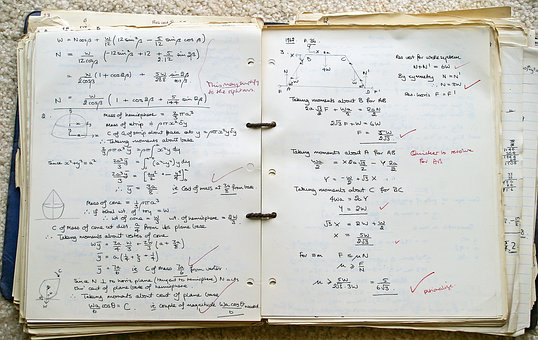 Write now, I am fighting the age old battle of getting lower performing students to show their work. I have a few students who refuse to show their work because they know the answer. All the work I've given them so far have included the answers so they can check their work as they go. When you have the answers, its easy to figure out the solution.
I've had them work a few problems without the answers available to check and they run into problems. They don't buy the "Its easier to find a mistake if everything is written out" or "if the problems are more complex it is not as easy to do in your head so if you work on learning steps now, when you need them, you'll know them". I also fear they want to wait till they get home to run the problems through one of those apps that shows them the steps and the answers.
So I have two choices here, let them just put the answers down without showing their work and count it totally wrong or continue fighting the battle. Honestly, I'm not ready to go that way yet, because the group I work with have struggled with math and I'm trying to help them build a better foundation. So I've come up with a few ideas that will keep them "showing their work" while learning the steps so they are prepared for more complex problems. These activities are for two step equations and higher.
1. Divide the students up into groups of four, Each person in the group is assigned a number from one to four and each is given a problem. The first person writes the problem on the board. The second person performs the next step, the third person will write the next step and the fourth person writes the answer.
2x + 1 = 7
-1. -1
2x = 6
2. 2
x =3
When they've finished the problem, they can all write it down. For the next problem, The second person begins by writing the problem, the third person does the first step, the fourth person completes the second step and the first person writes the answer. They continue with the third person beginning the a problem, and cycles through. This way each person has a chance to do every step of the process over four problems. At the end they will have four problems completed and they can begin the process again for another four problems.
2. Set up slides so the first person writes the equation, the slide is duplicated so the second person adds the second line, the slide is duplicated again with the two steps so the third person adds the third line, the slide is duplicated again and the fourth person writes the answer. At the end the slides are connected with transitions to create a video and they can add a voice over explaining each step.
3. If a student thinks they know the answer, they can verbally explain their thinking on how they came up with the answer while writing down the answer. I think if they can explain how they got their answer, that will work just as well as showing all the steps.
These are just three ideas I've come up with to get students to learn to show work because once we add in the distributive property, like terms on both sides , throwing in some absolute value and a few other things, it is not as easy to do it all in their heads. By learning to show it with the simpler problems, they know what they should be doing to solve the problems.
Let me know what you think, I'd love to hear. Have a great day.
Tuesday, September 10, 2019
Mathematical Based Art.
 When one comments about mathematically based art, most people automatically think about tessellation's. It's easy to have students cut a base pattern piece out to use repeatedly to create art but that is not the only thing we can do that is mathematically based.
This site has a bunch of different math based art projects that students will enjoy and still get a dose of math in them. The first activity they discuss is the "Curves of Pursuit" which is based on the three bugs problem. Basically you have three bugs traveling at the same speed and if you follow their paths, you end up with some wonderful curves.
This activity comes with a presentation to show students example of this art work before explaining how to construct these beautiful pieces of art work. Furthermore, there are templets to get the basic shapes and examples of what the finished product might look like.
Another activity suggested is to have students create Celtic Knot work. This is a bit more complex than the previous exercise. It comes with a presentation giving information on both historical and modern examples. The presentation also includes step by step directions to do basic Celtic Knot work. They also have a handout showing how to create one step by step with illustrations.
They also have directions for creating impossible triangles, impossible rectangle, and an impossible three pronged object. As with all their art, they include a great presentation showing various impossible objects and directions. An impossible object is one that looks like it twists into itself. Furthermore, there are activities designed to explore insect symmetry which has students use tracing paper to create the symmetry of the insects.
There is also an activity where students learn to create both mazes and labyrinths using square grid paper. One on creating modern art in the style of Ellsworth Kelly. Ellsworth Kelly is a modern American painter known for his hard edged paintings. He was born in 1923 and died in 2015. This uses fractions, decimals, and percentages to create the effect.
Then students could make cardidoids using a curve stitching technique which is the use of straight lines moving around a point to finally produce the shaped item. This technique could be done with string or with pencils. Students can also use shapes to create paper patchwork patterns similar to those found made in cloth. This activity opens up an opportunity to develop rich mathematical conversation.
The last two possibilities for art activities are snowflakes made out of paper using reflective symmetry and Islamic Geometry using a four fold pattern. Each and every activity has background information and handouts to make it easier to teach if you've never taught art before. This site has enough activities to spread out over a year and is not restricted to only elementary school.
Let me know what you think, I'd love to hear. Have a great day.
Monday, September 9, 2019
Word Problems Increases Mathematical Communications
 It is only recently I realized that word problems serve a purpose other than driving students crazy. I admit some of the problems are very hard to relate to when you live in the middle of a village of under 900 people with no traffic lights, no buses, a few stop signs, and no roads that go anywhere other than the dump or the river.
So I figured out a reason to work word problems other than they are part of life. Word problems present the perfect opportunity to help students increase their mathematical communications. Often times, student struggle to understand the written problem which makes it more difficult to turn the language into symbols in a mathematical equation.
There are several factors contributing to this problem. Students often see there is only one type of word problem rather than understanding there are multiple types. They are also generally taught specific methods to solve word problems which does not work if the word problem is not written to match one of those methods, and many students are not good at their number fluency. In addition, its been found that many students are unable to write the answer to a word problem using correct mathematical terminology.
The process of solving word problems involves a lot of communication.They need to have a good grasp of mathematical language so they can properly communicate their thoughts, the method they used to solve the problem, and their final solution. This all has to utilize proper syntax and grammar within the language of mathematics.
One of the best ways to increase mathematical communication is through the use of writing, because writing requires formal use of language. Unfortunately, most teachers assume since students take English, they know how to write but with the specialized language in math, teachers need to take time to teach students how to write their way through the process.
Solving word problems involve two steps, the problem representation and the search for solutions. The problem representation can be further subdivided into three parts, comprehension, extraction, and construction of the equation or equations. This boils down to understand the problem, figure out what they have to find and what information is needed, and creating the equation needed to solve it.
It is important for the student to represent the information in a way that is meaningful to them thus making the problem more accessible to them. It doesn't matter whether they use diagrams, notes, or drawings to represent the information, because this step helps them organize their thoughts. This step requires the student have a good basis in mathematical language. It is strongly recommended students read the problem several times before they reword the information to show their understanding. The better they comprehend mathematical language, the easier it is for them to create the problem.
The second part, the search for solutions, involves solving the actual equation. Once the answer is found, it is important for the student to identify if the answer is reasonable and double check their calculations. Once the answer is verified, the student needs to write out the correct solution while using proper syntax and language to communicate what they found.
So as a math teacher it is important we take time to discuss writing our answers correctly using mathematical language in addition to giving students guided practice in learning to do that properly. This involves more than just going over the steps used to solve the equations, it also involves language used in writing word problems and in explaining our answers.
Let me now what you think, I'd love to hear. Have a great day.
Sunday, September 8, 2019


Subscribe to:
Posts (Atom)