
Saturday, September 30, 2017

Friday, September 29, 2017
Book Creator
 Last night, I had a blast participating in a one hour web instruction where I learned to use the Chrome based version of Book Creator.
This app/web based app allows one to create a book with photos, comic strips, videos, text, and other things.
After a short hour with 5 tasks, I feel comfortable enough to use it and help my students learn to use it. It is easy and quite intuitive
I am always looking for ways to integrate more writing into my classroom so my students have a chance to use it outside of English.
In addition, when they have to explain the math through writing, movies, and pictures, it helps clarify their actual knowledge and helps them practice their mathematical language. In regard to the writing segment, they must use their language properly, be able to explain the concepts clearly, and provide proper examples.
As for visual, they need to create drawings or pictures able to convey the ideas clearly. It is important for students to be able to do this to show they understand the concept behind the written representation. Furthermore, if needed they can also create a video showing real world applications or creating a news report sharing the mathematical concept.
This way they see it, say it, and hear it as they create the book. As the teacher you have a choice on how it can be done. The students can each create a book or each student can create one to two pages for a book. I like the option.
There is a way for the teacher to monitor student progress as they create their pages or books. The price for 40 books in one library is perfect if your school is on a budget - free otherwise there are two options which allow more libraries and books but do cost something.
I am all for using apps which allows students to express their understanding of mathematics in more interesting ways than just solving equation after equation using processes without understanding the underlying concepts.
Check it out, have fun and let me know what you think. Have a good weekend.
Thursday, September 28, 2017
Brain Breaks
 Again, I'd like to thank Twitter for this topic. Its new to me that I'd like to share. It's referred to as "Brain Breaks" or taking a physical break to stimulate the brain into learning.
Brain breaks incorporate some sort of physical activity into the classroom for a minute or two every period. A brain break is designed to clear the brain pathways of stress and overload so the brain is able to learn at its optimum.
It has been discovered that for the brain to absorb new material, the information must pass through an emotional filter called the amygdala before reaching the prefrontal cortex.
When students become to stressed out or overloaded with information, the emotional filter is activated to the point, information is unable to reach the prefrontal cortex. Brain breaks are designed to help return the brain to a state of optimal learning. Switching mental activity allows the brain to shift communications to fresh networks of neurotransmitters which allows the brain's chemicals to replenish within the resting networks.
As a general rule of thumb, brain breaks should occur after 20 to 30 minutes of concentrated activity for middle school and high school students. The good news is that brain breaks need not interfere with instruction. A brain break may be having students do a quick stretch, have them move to another part of the room, or even put a short piece of music on to dance to.
I usually include some sort of movement in my classroom but not as regularly as I should. Some of the things I do is to prepare several multiple choice questions for my Smartboard. I have the corners of my room designated as A, B, C, D and they must go to the corner of the letter they believe is the correct answer.
I do not have students pass out work, I place any sheets, books etc away from the students and they must get up to get the assignment. Yes, it takes a couple minutes but the students are up and moving. In addition, I allow them to check notes for their tests but their notes are spread around the room. If they want to check their notes, they have to get up, walk over, look at the notes before returning to their seats to work on the tests. All tests remain on the desk.
I remember reading about a teacher who kept a ball in the room. She'd have students stand up, ask a question, then toss the ball to a student to answer the question. She'd ask another question and that student tossed the ball to another one to answer the question and so on. The ball indicated the person had the floor.
Here are a few other suggestions I found that I like.
1. Desk switch - have students grab their materials and find another desk to sit in for the rest of the class period. By changing desks, they get a new perspective on things. Be sure to set a time limit or it might take the rest of the period.
2. Sky writing - have students write a message in the air to a friend.
3. Give students a chance to play "Rock, Paper, Scissors" for two minutes while away from their desks.
4. Thumb wrestling.
5. Mirror - Mirror where students are broken up into pairs. One student mirrors the actions of another student.
6. Pantomime - choose a student to act out an activity without talking. Students have to mimic the leader and then guess what the activity is.
Let me know what you think. I hope you all have a great day.
Wednesday, September 27, 2017
Real World Piecewise Functions

After creating the hands on activity, it hit me, I didn't know when the piecewise function was used in real life. There has to be some application because it exists since mathematics often explains the world.
So after a bit of research, I discovered several real world situations that are not contrived and make sense to me.
I assume most people reading this column have at some point worked a job where you were paid by the hour. I had one where I worked filling the newspapers with sales flyers so I'd have days free to substitute and look for a teaching job. The place I worked set the pay with the following parameters: I was paid a per hour rate for the first 8 hours worked in a 24 hour period from midnight to midnight. Anything over the 8 hours and I received time and a half for those hours. If I worked holidays such as Christmas, I received double time. That makes my pay a piecewise function because the amount I received depending on the number of hours I worked.
For many other jobs the piecewise is based on working a 40 hour week before a person begins to receive time and a half for overtime or double time for certain holidays or Sunday. It all depends on the rules of the business.
Another piecewise function is based on the amount of something purchased. The more of the one item you purchase, the less per item you pay. I've dealt with a company where I paid full price for the first 10 items, the next 20 granted a 10 percent discount, etc. I've seen this type of arrangement with t-shirts, water bottles, etc.
Look at the launching of a rocket and follow its acceleration from launch to touchdown to see a piece wise function. For the first two seconds, the rocket accelerates from zero to a certain speed. Between two and twelve seconds, the rocket slows down as it begins to coast and due to gravity. After 12 seconds, the parachute is released and the rocket floats back to earth. Based on the above situation, I think anyone who jumps out of a plane is going one velocity until they pull the ripcord causing the parachute to open and they are now floating down.
The next time I teach this topic, I can provide examples without students having to ask. I feel like I've scored a win.
Let me know what you think. I love to hear from people. Thanks for reading.
Tuesday, September 26, 2017
Mathematical Selfies.
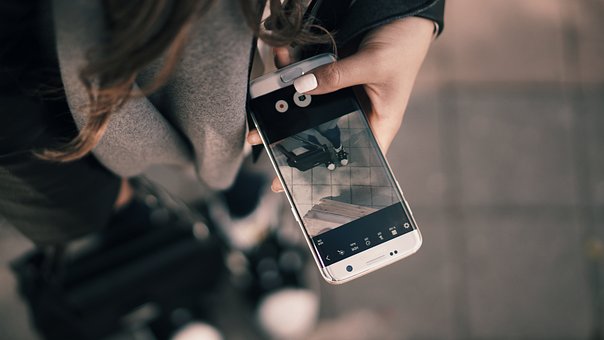 The idea for this column came from an article in the September 2017 issue of the Mathematics Teacher on mathematical selfies.
The idea behind mathematical selfies is to have students go out into the world to find examples of various mathematical concepts they can share.
For instance, pictures of a city skyline resemble a histogram, or a row of trash cans provided by the city show congruence since they are all the same.
Take a picture of a mountain range and you have a wonderful example of a polynomial function. Or a picture of a musical score can be used to show fractions. Take a picture of shadows created by a house, apply parallel lines and transverals and you can identify a variety of angles.
The author, Kathy M.C. Juqua, teaches an informal Geometry and Mathematics concepts class. Students chose to use selfies in a variety of ways. Over the semester, students are given 45 terms to work with. Some found pictures representing different vocabulary terms to create individual visual dictionaries.
Others, alphabetized the terms and created a more traditional dictionary with definitions and pictures. Some took the terms, divided them into groups so they could make connections between terms with their selfies. In addition, students made study aids, and compilations.
Another teacher, Rachael Miller assigned her students to take photos from their daily life, annotate them explaining a mathematical concept they are learning in math class. The annotation provides a way to assess a student's understanding of the material.
She used it as a homework assignment. At the beginning only a few students submitted their answer but after sharing the photos with the class, others began to turn their entries in until everyone was doing it.
I am glad I ran across both articles. This might be a way to get my students more interested in mathematics by following Ms Miller's idea for a homework assignment.
Let me know what you think. I'm thrilled to have read both of these works. Have a great day.
Monday, September 25, 2017
PIecewise Function
The idea for this column came from a question posted on Twitter about ways to help students understand piecewise functions better. I can understand the teacher's request for help because our students have difficulty combining two or more functions into one graph.

I gave it some thought and came up with an idea I thought I'd share with everyone. It is a physical way to see how they combine.
First draw the two individual graphs on graph paper. I made the one shown to the left. I included the two functions, I listed as an f(x) and g(x).
I used two different colors so the graphs are distinguishable as possible.
 In the second photo, I show the individual graphs against a white background.
This prepares the student for the next step. Since the x^2 graph is used till the value of x = 1, the students will cut the graph at x = 1.
The second graph is also cut at x = 1 because that is where the second piece begins.
 For the final step, have the students tape the two graphs together at x = 1 so they match up.
With the two colors, it is easy to see where one graph ends and the other begins.
At this point, students can put in the circle indicating the < part to see how well they fit.
The last piece would be having students fill out a small questionnaire in which they use the completed graphs to determine which graph is associated with which part of the graph.
I might ask "f(3) is found on which graph?" so they have to relate values to points and lines.
Students can repeat this exercise with several different piecewise functions to see how the functions fit based on the criteria. Some will have a smooth transition like this one while others have huge jumps between one function and the next.
I also found this game called Polygraph: piecewise functions on Desmos. It is designed for students to improve their vocabulary regarding piecewise functions, first by playing against the computer, then against each other only after answering questions designed to help them reflect on what they are learning.
I think part of the problem may be that students are not exposed to these types of functions until they hit high school. I don't think its covered in middle school. I do teach it but usually not until Algebra II because I'm usually bringing my Algebra I students up to where they should be when they enter the class.
In a couple days I will discuss the use of piecewise functions in real life. When I took math in high school and college, the teachers never discussed the situations one runs into where they might have to use these types of functions.
Let me know what you think. In the meantime, I'm working on ideas for sketch notes and graphing activities for linear inequalities and systems of linear inequalities. I'll share those when I get them developed.
Thanks for reading.

I gave it some thought and came up with an idea I thought I'd share with everyone. It is a physical way to see how they combine.
First draw the two individual graphs on graph paper. I made the one shown to the left. I included the two functions, I listed as an f(x) and g(x).
I used two different colors so the graphs are distinguishable as possible.

This prepares the student for the next step. Since the x^2 graph is used till the value of x = 1, the students will cut the graph at x = 1.
The second graph is also cut at x = 1 because that is where the second piece begins.

With the two colors, it is easy to see where one graph ends and the other begins.
At this point, students can put in the circle indicating the < part to see how well they fit.
The last piece would be having students fill out a small questionnaire in which they use the completed graphs to determine which graph is associated with which part of the graph.
I might ask "f(3) is found on which graph?" so they have to relate values to points and lines.
Students can repeat this exercise with several different piecewise functions to see how the functions fit based on the criteria. Some will have a smooth transition like this one while others have huge jumps between one function and the next.
I also found this game called Polygraph: piecewise functions on Desmos. It is designed for students to improve their vocabulary regarding piecewise functions, first by playing against the computer, then against each other only after answering questions designed to help them reflect on what they are learning.
I think part of the problem may be that students are not exposed to these types of functions until they hit high school. I don't think its covered in middle school. I do teach it but usually not until Algebra II because I'm usually bringing my Algebra I students up to where they should be when they enter the class.
In a couple days I will discuss the use of piecewise functions in real life. When I took math in high school and college, the teachers never discussed the situations one runs into where they might have to use these types of functions.
Let me know what you think. In the meantime, I'm working on ideas for sketch notes and graphing activities for linear inequalities and systems of linear inequalities. I'll share those when I get them developed.
Thanks for reading.
Sunday, September 24, 2017

Subscribe to:
Posts (Atom)