Showing posts with label Assessment. Show all posts

Friday, March 12, 2021

The New Assessment.


Since Covid hit a year ago, we’ve had to readjust our thinking on how to assess students, especially if having to teach by distance.  There are ways to create assessments for these times.  One of the first things recommended is to quit assessing everything students turn in.  I know I had to get my students over the “Will this count for my grade?”.  They seemed to think that they should receive credit if they turned it in but I only grade some of it but I don’t tell them which ones I’ll be grading.


Performance tasks and projects are wonderful for this situation but they should be designed so that students are required to apply their knowledge to new and different situations.  When performance tasks are applied to new and different situations, the teacher is creating an potentially engaging opportunity for them to apply multi-standard thinking. 


If performance tasks and projects are designed to be large, multi week assignments, one might consider breaking it down into smaller units, especially if it requires students to research a topic.  When a big task or project is broken down into smaller units, students are less inclined to feel overwhelmed.  


Rather than assigning tons of problems, cut down on the number of problems to one or two and have them create a google slide showing their work and then they can record an explanation of their thinking as they solved the problem.  They could discuss what they had trouble with on the problem, or where they got stuck, or where their thinking was wrong. Or students could create videos to share how to do a problem with the others.  They become the teacher and help other students.  


Take advantage of technology tools such as google classroom to administer tests and quizzes.  If one chooses the short answer possibility, students can provide a written explanation of their work or show their work for the problem.  It is also possible to create  multiple choice questions but I’ve discovered one has to check student answers because if their answer does not match the solution exactly, it might be marked wrong. 


I’ve been known to assign a Kahoot or Quizzes to students and disabled  the timer so students didn’t feel rushed when completing it. I analyze the answers and assign a grade based on their work.  I’ve found that students usually like the games so much, they want to complete the assignment rather than trying to “find” the answer on the internet.


Hopefully, everyone will be back at school for the 2021-2022 school year but if not, these are some things to think about.  Let me know what you think, I’d love to hear.  Have a great day.

Monday, January 7, 2019

Assessment

Fax, White Male, 3D Model, Isolated, 3D Sorry there were no warm-ups posted over the weekend but I got stuck in a town for a few days waiting for the weather to clear up enough to fly home.  I managed it but the next day the weather got bad again.  So while waiting for the weather to clear, I wasn't able to do much.

Now on to today's information.  When looking at assessments, its important to decide what the assessment is for.  Lets look into the four different types of assessment designed to improve learning.

Assessment should make learning better while supporting good instructional technique.  In other words, instruction and assessment should support each other.

First off, assessment can help the student determine what is more important to learn.  This means, students should be assessed on specific topics. For instance if they are learning about greatest common factors, they should be assessed on that topic.  If they have been learning to use greatest common factors to simplify fractions, that is what they should be assessed on.

This type of assessment is not only teacher driven, it can be used by students to help them assess themselves.  Furthermore, it has been discovered that learning is really restructuring prior knowledge rather than adding to it so assessments can be developed to help improve learning.

Second, students must be able to construct new knowledge from previously learned materials and the proper assessment can help with that.  One way to do that is through assessment tasks which are similar to learning tasks with data analysis, making connections, and making contrasts.  Large groups are often optimal for learning and assessments designed for whole group must reflect that.  Group work is a very real life situation because many businesses have groups find solutions to problems.

Third, if students have been learning mathematics using tools such as graphing calculators they need to be assessed while using them, otherwise the final picture is incomplete.  Furthermore, many of the standardized tests require students to use certain tools so if they do not know how to use these tools, they are at a disadvantage.

Finally, students need to be assessed on more than the usual automated tasks.  They need to be assessed on how well they've connected with the current topic, how well they can see how things connect even with superficial differences, the ability to use the appropriate process, and their own understanding of the material.


Tomorrow we'll look at a different idea on grading tests which I recently read about.  Let me know what you think, I'd love to hear.  Have a great day.

Monday, June 12, 2017

Formative Assessments

Quiz, Test, Exam, Questionnaire  Last week while at the Kamehameha Schools Educational Technology conference, I had the pleasure of attending a session devoted to formative assessments.  This is one of my weak spots because I hate creating and "grading" assessments in general.

The speaker sent us to five different sites containing online tools designed to engage the student while providing assessments.

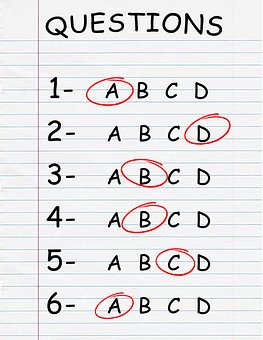
The first is Plickers.  I'd heard of it but hadn't ever used it.  No one at school is familiar with it. It is free and easy to use.  It uses a paper printout with a number and the letters A to D.  You post the question, the students hold up the paper with their answer at the top and the teacher scans it using an app on their phone or ipad  to get the number of correct and incorrect answers. 

I got to play with it and it was fun because I didn't have to do anything other than determine the answer and hold up the form.  The speaker indicated it is not good to laminate the cards because the light can be reflected making it harder for the scanner to record the answer.  In addition, you can get reports at the end so you don't have to grade it.

Next was Quizzizz which can be setup as a game with a code so students can use the code to enter the classroom.  I gather each student gets questions but not the same questions at the same time.  There is a library of quizzes created by others or you can create one from scratch.  The quizzizz can be done in class or as "homework" depending on what you want.  This is another one that provides reports and it has an ipad app available.

Then we explored Go Formative, another online formative assessment site. The instructor set up a quiz to take using the class code created by the site. This one allows the instructor to create an assignment with questions for the student to answer.  Once the students have completed the assignment, the teacher gets live results and feedback is provided.  Sweet quick and easy.  What is nice about this one, is questions can require students to show their work.  Its rather nice

The last online site is Google Forms in which the teacher creates the quiz.  The link includes step by step directions for doing it.  I prefer the other ones but if you are using google, this is just another facet of the Gsuite.

The final form is called "My Favorite No".  Put a problem on the board.  Pass out small pieces of paper or 3 by 5 inch note cards.  The students work out the problem.  The teacher collects them and sorts the answers into two piles for yes or no.  Then the teacher goes through the no stack choosing his or her favorite no.  The teacher then places it on the board and the class first discusses what is right about the problem before looking at where the mistake was made.  This gives the teacher a quick grasp of the number of students who understand the problem. 

I knew about the last one but none of the others so I now have a few more tricks in my bag which should make life easier next year when I teach.  I know what classes I'm teaching next fall so I am starting to create my units.  This way when school starts I'll have them done and I'll be ready to go.

Let me know what you think.  Have a great day.

Monday, September 28, 2015

It Worked!!!!!!

Mathematics, Board, School, CountToday in my second period, I gave a few problems out to work on their iPads and it gave me a true feeling for how well they knew the material.  I had one student who had no problem doing it and everyone else struggled with solving two step equations.  It was awesome!

I could just look and see exactly where the student was having trouble.  Most got started well but a few had trouble figuring out which term they needed to work with first.  The majority moved the constant and then got stuck.  So that gave me an idea of what to teach today.  It was a very focused lesson.

Later on, after a focused lesson, I had the students work with the  cover-up app. 
They could either solve it using the standard method or just remove the variable so instead of 2(x + 1)= 7  So it read  2(   ) = 7.     Once they put in 3.5, they are asked to solve x + 1 = 3.5

I like giving students more than one way to look at a problem and more than one way to solve it if they can.   Overall, it was a great class.