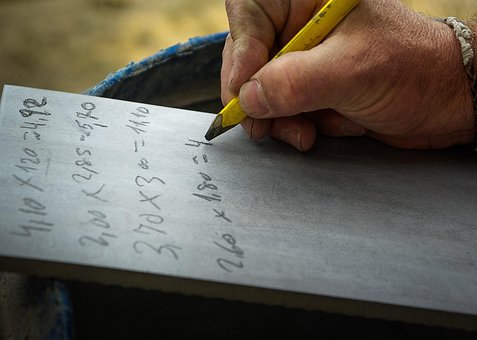
The primary architectural constraint of the human mind during problem-solving is working memory. Working memory has a strictly limited capacity. When a middle school student encounters algebraic equations, such as finding the common denominator for x⁄6 + y⁄8, their brain must dedicate cognitive energy to processing that new concept.
If the student lacks automaticity—the ability to instantly recall that the lowest common multiple
of 6 and 8 is 24—they must stop, pull out a calculator, or manually write out multiples. By the time
they find 24, their fragile train of thought regarding the overarching algebraic structure has frequently derailed. Basic math fact memorization acts as a cognitive offloading mechanism, clearing mental bandwidth for high-order logic. Calculators are excellent tools for execution, but they cannot replace the internal framework needed for evaluation. True number sense tells a student whether the screen's output is
logical.
Number Sense vs. Mechanical Dependence
Over-reliance on calculators creates a vulnerability in a student’s "number sense"—the intuitive
understanding of numbers, their magnitudes, and their relationships. A student fully dependent on a device might type 45 × 9, accidentally press the divide key, get 5, and accept it as truth. Conversely, a student with strong number sense instantly recognizes that the product must be slightly less than 450.
Calculators belong in modern classrooms, but their optimal utility occurs after fluency is
established, not before. They should be leveraged to navigate massive data sets, explore intricate
mathematical patterns, or graph complex trigonometric functions, rather than serving as a basic
arithmetic crutch.
established, not before. They should be leveraged to navigate massive data sets, explore intricate
mathematical patterns, or graph complex trigonometric functions, rather than serving as a basic
arithmetic crutch.
Balancing Fluency with Conceptual Understanding
The solution is not a return to the high-stress, timed mad-minute drills of yesteryear, which often
succeeded only in convincing children they were "bad at math." Instead, educators must strike a
deliberate balance: building fluency through conceptual understanding. We can foster authentic mathematical fluency without resorting to dry, rote repetition by utilizing modern classroom strategies:
One is by using visual number talks where we encourage students to mentally manipulate numbers and verbally share strategies (e.g., breaking down 7 × 8 into (5 × 8) + (2 × 8)).
Another is to use mathematical games that utilize targeted card and dice games that naturally demand rapid retrieval of sums and products within an engaging, low-stakes environment.
Don't forget targeted strategy building. By shifting focus away from memorizing isolated facts towards
mastering foundational patterns, such as the "doubles plus one" strategy for addition (6 + 7 = 6
+ 6 + 1).
Ultimately, memorization and conceptual understanding are not mutually exclusive enemies in a
pedagogical war. They are deeply symbiotic. True mathematical fluency equips children with the
agility to play with numbers, the confidence to tackle advanced logic, and the critical awareness
to use calculators as extensions of their minds, rather than replacements for them. Let me know what you think, I'd love to hear.