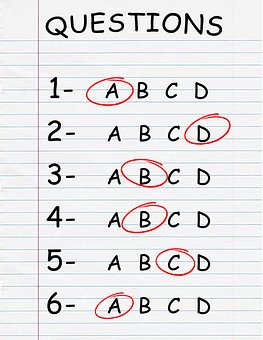
Even though I don't like giving this type of test, it is important that students learn to take them and not just guess. In my textbook, the pre-tests for each chapter are multiple choice along with certain questions in the problems for each section. Many students need to be taught how to take multiple choice tests effectively.
There are strategies to help students when taking multiple choice questions. First, students should cover up the potential answers without even looking at them before they read the problem because they need to know exactly what the problem is asking. If they cover the answers, they do not get distracted and they can reread the question multiple times to understand it.
In fact, it is recommended that students rephrase the question to themselves, before trying to answer it in their mind first. If the problem requires calculations or simplification, students should try to answer the question before they look at the answers otherwise, many students tend to guess rather than trying to do the problem. If the problem requires them to find an equivalent equation or find a fraction closest to a number, they should still cover the answers to they are focused only on the question before going through each answer slowly to see if the answer goes with the question.
Secondly, have students highlight key words, especially words like always, never, sometimes, not and others that place limits on the situation. The question might ask you to find the probability of not drawing a red or green ball, rather than asking for the probability of drawing a certain colored ball. Many students miss the qualifiers if they don't highlight certain key words.
Next, after reading the question and highlighting key information, students should read through the answers to eliminate any that are obviously wrong. If a student does not see any that are obviously wrong, then there is another technique to use. If the answer required is an actual number, one can substitute the answers back into the original equation to see which one makes the whole problem correct. I've used this last one myself on multiple choice questions.
One person analyzed over 2400 questions from 100 different tests to determine the four strategies to help increase a person's chances of getting multiple choice questions correct when they don't know an answer. First, if you have see "None of the above" or "All of the above", one of these is likely to be the correct answer over half the time. Secondly, two questions in a row seldom have the same answer. For instance if you don't know the answer to question 2 but know the answer to question 1 is a and the answer to question 3 is d, then chances are question 2 will not be either a or d. Next, the correct answer is more often than not the longest answer because the people who write the test want to make sure the correct answer is definitely correct. They are not going to take as much care with an answer that is wrong. Finally, eliminate any questions that are out there. Often, on math tests, people can eliminate answers that are too small or too large just by using estimation.
I also tell students to keep an eye on the time if the test is timed. Always do the questions you know how to do first, followed by those you sort of know, and leave the ones for last that you have no idea how to do. You can do this for some computer tests but not for all and it works well for paper based tests. I advise students to spend no more than two minutes if they get stuck on a question otherwise they'll get frustrated and not be able to complete the test. I also include some practice questions with their homework. Let me know what you think, I'd love to hear. Have a great day.