Friday, June 7, 2019

Imathland

This is an app I found in the App Store for math. I decided to download it and check it out because I'm always on the lookout for apps that are better than those that write out the information and you just read.

The description made it sound a bit better but you never know until you give it a try.  The app just has the name when it opens up but if you hit the button on the top left side, you get a menu telling you what topics it covers.  Some of the topics include trigonometry, polar coordinates and order of operations.

The menu has drop down arrows so you know there is more than just the topic.  When you hit the arrow, you get the exact material covered in the section.

This makes it nicer because you know ahead of time what you will be looking at.  Unfortunately, some topics have more of a general presentation such as trig and polar coordinates while others get much more detailed such as in order of operations and linear equations.

The nice thing is no matter which type of presentation it is, the material is covered in a very interactive way.  For just about every screen, you are required to input some sort of information and you get immediate feedback.
The section on graphing linear equations

The graphing linear equations covers all three forms.  It has you select the form you want and then you must put choose values so the application can show you where the numbers are substituted into the formula.

If you notice, I was asked to select a b and a m for the slope - intercept form.  Once I select the value from the drop down menus, the program takes the values and shows me where they go into the y = mx + b using one color for the slope and another for the intercept.

It is great since it makes you a part of the teaching process rather than providing all the notes.  Once the equation is shown, the program goes on to graph the equation using animation so you see the starting point and the line.

This screen shot is out of polynomials.  It shows how to combine like terms with an explanation of what is going on and what you need to do.

The next screen has you try it yourself.  Again if your answer is correct, it turns green, if it isn't correct, it turns red so you get immediate feedback.

The only thing is that it doesn't tell you why you missed it only that you did get it wrong.


As you can see, I did one of the addition problems of 6x^3y^2 - 10x^3y^2.  I got the answer correct. down below the problem it told me I needed to use the ^ to indicate it was a power.

Although this still has a few things I'd like to see, it is more interactive than many others I've seen and the best thing is that it is free.

If you've used it let me know what you think of it. I'd love to hear.  Have a great day.


Thursday, June 6, 2019

Mixed Reality

Virtual Reality, Vr, Headset, Glasses
Yesterday was the last day of a great Educational Technology Conference in Honolulu.  They had tons of great material including some long sessions are programming, design thinking, and Virtual Reality and Augmented Reality.

 One of the things I discovered were Augmented Reality Books where you download an app for the book.  You then point the digital device at the page and something from the page pops up such as a bug, or a dog, or the solar system.

Along the way, I discovered something called Mixed Reality.  Before discussing it, I'm going to review a couple of definitions.  Virtual Reality or VR is where the person is immersed in a completely artificial world sort of like the Holodeck on Star Trek.  If you ever see a 360 icon in the corner of say a video, the icon means you can use a headset to experience the virtual reality.

Augmented Reality or AR is where something artificial is placed in the real world to enhance it.  Mixed Reality or MR, also known as hybrid reality,  is where the viewer can react with both the real world and the virtual world together.  The biggest difference between AR and MR is in MR, you can react with the virtual objects  or you can start with a virtual world with the virtual overlapping the real world rather than ignoring it.

Mixed reality is considered the most interactive of the three.  Many of you have played a game using mixed reality.  I can see people frowning and thinking.  If you've played Pokeman go, you've played a mixed reality game.  Unfortunately, there is not much out there on using mixed reality in math.

Several people at MIT have been working on "Mathland" which is a mixed reality world where students interact with their environment to learn math more naturally.  They created a mixed reality world filled with mathematical concepts for students to interact with as a way of learning mathematics.  Initial results are encouraging but if you want to read more on the topic, check these articles out.

One interesting thing about mixed reality is that it is often referred to as virtual reality or augmented reality because the activity is set up so the student can experience being on the titanic as it sinks.  I believe activities such as this are classified as mixed because the construct is completely artificial but it is based on reality and the students interact with their environment.  Unfortunately, these types of experiences for math students are not as easy to find.  The technology is here but the topic isn't.

If you know of any mixed reality math programs or experiences, please let me know, I'm always on the lookout for new ideas.  I came away from the conference with a merge cube and a beautiful headset.  Talk about exploring, I am going to have fun.  Let me know what you think, I'd love to hear.

Tomorrow, I'll be reviewing a math app that is new to me.  It is instructional but it includes an interactive component that makes it more engaging.  Have a great day.


Wednesday, June 5, 2019

Plickers

Quiz, Buzzer, Play, Button, CompetitionI am attending a technology conference in Honolulu right now.  During one of the presentations on free tools and technologies to use in the classroom, Plickers came up.  I've seen it before but I keep forgetting about it.

Plickers is a way to incorporate formative assessment into the class in a very interactive way.

The teacher downloads the accompanying app because the app is what the teacher uses to read the responses.  They also download the cards for free from the company or they can buy a laminated set from Amazon.  The card has a number on it and the letters A, B, C, and D for multiple choice, true/false or survey questions.

Once the teacher has both of these set up, they can set up one or more questions to check student understanding.  The teacher shows the question, students hold up the card with the appropriate letter up and they then scan the cards in the room with the app.  The app records all answers and sorting them into correct and incorrect so the teacher knows who got it right.

In addition, the program is set to produce reports giving the teacher information breaking down who got the question right or wrong and this information then appears in a spreadsheet with color coding so you can see how each student does over time.  The color coding lets the teacher see at a glance how well they did in terms of percent of questions answered correctly.

I can see using this particular program in math either to check new vocabulary by giving choices of definitions or even what its not.  It could be used to check their understanding on the process in the form of showing part of a problem and asking "What is the next step?" either by having the actual line or having the answer in verbal form.

It is possible to use true or false questions as the second step of the problem is correct, true or false.  Another way of using true or false is if the last line is the proper next step.  So many possibilities.

There is a wonderful checklist that appears when you first check in to lead you through the process of setting everything out.  Have a great day and let me know what you think.  I'd love to hear.

Tuesday, June 4, 2019

Mathematical Modeling and Surf Boards

Surfer, Surfing, Surf, Ocean, Sea, WaterSurf boards have so many variations depending on what you want and what type of surfer you are but how much of the design is based on scientific or mathematical research?

A lot of the adjustments and choices are based on how well various surfers do.  The idea is that if it worked for them, it should work for everyone.

Considering over 2.5 million surfers in the United States in 2016 which was up 40 percent from 2004, interest in the scientific community has also increased.

In 2017, Cranfield University in the United Kingdom published a report in the Journal of Sports Engineering and Technology explains the results of their mathematical modeling of fins on a surfboard.  The fin is the small curved piece sticking off the bottom, and a surfboard may have one, three or four on the bottom.

They explored the idea that fluid dynamics could be modeled to model the peak performing fin because the fin is what helps surfers maneuver through the water while accelerating.  The fin causes it to go faster and to grip the wave giving them more control, or in other words it is a type of lift. Surfers want fins that emphasize lift while eliminating as much drag or slowing as possible.

The people who carried out the study decided the fin operates in water the same way the airplane wing works in air so they can use aerodynamic mathematical modeling to try to find the precise shaped fin that produces the most lift with minimal drag.  Beginning with the standard shape, they calculated lift to drag ratios before making adjustments to shape, thickness, depth, length, base shape, and curve until they created a fin with a 14.32 lift to drag ratio. This was a 62 percent increase over the original.

It took them 42 different iterations before they arrived at the final ratio.  In the overall scheme of things, the changes may not make much difference to the average surfer, this could make a huge difference to the professional for whom the smallest change can make a difference.  This is cool to know they can use fluid dynamics and aeronautics to lean more about the "perfect" fin.

Another man, Bowen,  due to the frustration of having to buy a board every 6 months or so because the boards would split, did some research and revamped the basic surfboard which lead to him starting his own surfboard company.  The normal technique is to place a piece of balsam wood in a piece of polyurethane foam.  This blank is then shaped into the proper surfboard shape before being finished.  Bowen revamped the traditional way of making surfboards by making his with layers because the layers give more flexibility making them more dynamic and less likely to break.

Let me know what you think, I'd love to hear.  Have a great day.

Monday, June 3, 2019

Surf Boards and Math


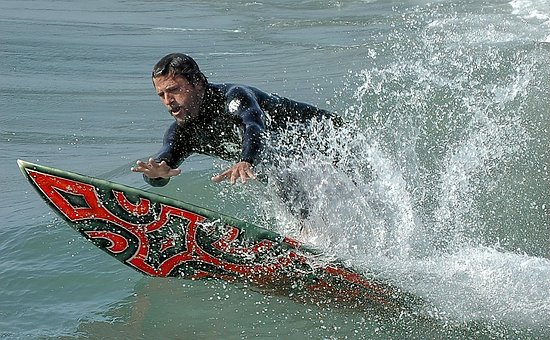
This past weekend, I took a few minutes to speak with Adam of T & S Surf Designs, organizer of the surfing contest for ages 6 to 12,  held this past weekend at Prince Kuhio beach in Waikiki.  He was quite willing to take time to discuss the mathematics used in the design of surfboards and how the surfers were judged at the contest. 

Most surfboards come in standard sizes of height, width, depth and volume because sometimes a surfer wants a shorter board with the same volume so the maker can make the appropriate adjustments.  The height is from top to bottom or tip to tail in proper language.  The sides are also known as the rail and the rocker or curve from top to tail.

Then as I was walking back from another trip out and stopped through Koa Board Sports where a very helpful gentleman explained the parts of a board in more detail.  He showed me the two basic types of tips, the rounded and the pointed one. 

He also explained about single fins, triple and quad fins, their uses and why you might want three instead of one. He also showed me boards with concave or convex places and some even have two concave spots.  He took time to show me the different types of curves you can find in a surfboard from tip to tail.

In addition, the longer the board, the less maneuverable it is and the thicker it is, the more resistance, buoyancy, and volume you have.  There is a lot of math involved in planning the curves, the amount of curve, placement of the different curves, length, width, depth, type of tail, type of tip, all based on the type of surfing you do and your experience level.  
For the contest, there are three judges who watch each competitor perform three runs.  They look for the length of the ride, the difficulty of the ride or how many different things did they do.  Some one who rides straight in will get fewer points than someone who zigs across the wave and back.
Out of the three rides, the lowest scoring one is thrown out while the other two rides are averaged to get a final score.  It is on these scores competitors place in the competition and determine the winners.  So they use an averaging system.

Tomorrow, I'll address mathematical modeling and surfboards in a bit more detail.  Let me know what you think, I'd love to hear.  Have a great day.