Tuesday, October 31, 2017

Halloween Math.

Halloween, Pumpkin, Dark, Art, Fantasy  Happy Halloween to everyone.  Most of the time when I've gone looking for Halloween based math, the ones I find are all geared for elementary school.

 I want problems geared for a higher level and which are more interesting than "Jane has 8 pumpkins.  She gives 3 to John.  How many pumpkins does she have left?"  My high schoolers are not interested in those.

So after some searching I found some lovely problems geared more for middle school and high school students.  Problems that are a bit more interesting.

1.  The worlds largest pumpkin weighs 2222 pounds in 2017.  The average pumpkin weighs 12 pounds, how many pumpkins does the largest pumpkin equal.

2.  The record for the distance a pumpkin has been thrown in the chuckin contest is 4484 feet.  What percentage of a mile is that? 

3.  The first Halloween parade happened in 1920.  How many months till it celebrates its centenial?

4.  Buy a couple packages of pumpkins from the seasonal section to create a matching game.  You might create matching games where one student multiplies two binomials while the other factors a trinomial.  The students do the math then look for who they match.  Another possibility is to create equations in pairs so they get the same answer. Another possibility, one card has the equation while the other has the graph to match the equation.

5. The Census bureau has some wonderful data concerning Halloween such as the number of potential Trick or Treaters ages 5 to 14, the number of potential stops based on the number of housing units, number of units with stairs, number of people employed to make the candy, and other wonderful facts.

6.  How about an estimation activity to estimate the number of seeds in a pumpkin, estimate the circumference, estimate its weight.  After the estimations, have students count the actual number of seeds to determine the closest guess, then make spiced pumpkin seeds to eat in the class.  After finding the circumference, calculate the diameter.  Finally after giving the weight to the students, have them bake the pumpkin and use the pulp to make pumpkin bread to eat.  You can weigh the pumpkin when you buy it so you'll already know that.

7.  Have students create a haunted house on a coordinate. They can then give the location of items within the haunted house.  They can also find the distance between each part. 

8. Students can create graphs containing the name of the candy, the number of calories per serving and its weight in grams.  Once done, students need to calculate the number of calories per gram so they can determine the candy with the highest or lowest per unit values.

9.  Begin a Pascal's triangle with pumpkins.  There should be enough pumpkins on the paper to help students recognize the pattern so they can finish it.  It can lead to a great discussion on Pascal's triangles.

Just a few suggestions to make math and Halloween a bit more interesting.  Have a great day and let me know what you think.  I love to hear.

Monday, October 30, 2017

Pumpkin Chunkin

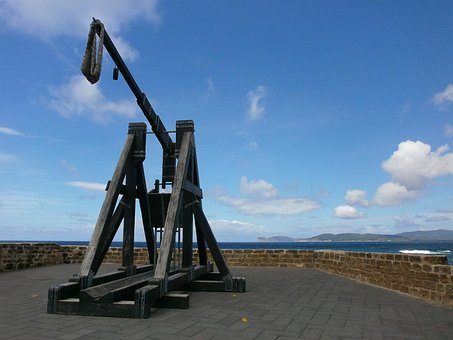
Catapult, Sea, Blue Sky  It is almost Halloween, the time of pumpkins and crazies who launch pumpkins with huge self built catapults.  This three decade old tradition raises funds for various groups and is due to happen the first weekend in November.

This event brings its followers in from all over the place.  I have friends who disappear for the weekend so they can go out to Delaware to watch.

There is some great math involved in this event from the parabolic projectile path to the time it takes for the pumpkin to travel across the field, etc.  Most people launch their pumpkins using some sort of air cannon to provide the force necessary to launch the object.

Lets start with finding the initial velocity by using the formula x*(k/m)^1/2 with m representing mass, k equals the spring constant, and x is distance in meters.  Since the pumpkin is being shot out of an object, you are dealing with projectile motion.  It is this motion which creates a wonderful parabolic shape. We can use the projectile motion equation d = (v^2osin(2theta))/g to find distance.  Add into this finding the time of the pumpkin's trip by using t = Vo sin(angle)

If they calculate the flight of the pumpkin without air resistance, then .  There is vertical and horizontal velocities, the angle of launch, and acceleration out of the cannon.  So you end up with the equation Vv= Vo sin(angle) and Vh =  Vo cos(angle).  A nice practical use for trigonometry.

If you add in drag, the equation changes to  drag = 1/2 * items density * speed^2 * area * drag coefficient.  Drag is what slows the object down and the area listed in the equation refers to the cross sectional area of the pumpkin which can be found using the equation pi * diamter^2/4.

Lots of cool math involved in shooting off a pumpkin. Yes it is mostly involves physics but its still the math involved when shooting a pumpkin.  So many things.  Just a fun fact, the pumpkin chuckers are still trying to hurl the pumpkin at least one mile but so far they have managed about 4,450 feet.

If you are interested in more math equations, just check out the internet for one of many articles with all the math equations needed to calculate just about anything to do with this event.  I chose just a few of the equations.  In addition, there are all sorts of plans to follow to build launchers.  Imagine having students build small versions of the launchers designed to launch those mini pumpkins.  Imagine having students follow up with the math to prove things. 

Let me know what you think!  Have a great day.  Tomorrow, I'm looking Halloween based math appropriate for use in the middle school or high school.


Friday, October 27, 2017

Pattern Blocks in the Secondary Classroom.

Roof, Brick, Colorful, Red, Roofing  My experience with pattern blocks is really next to nothing because I've only ever seen them used in the elementary grades.  I knew they could be used to teach parts of the whole but I never realized they could be used at the middle school and high school levels. 

I've actually discovered a few ways they can be used in the upper grades. I am thrilled because I have a collection of them from the previous teacher.    There are also a couple of apps for sale from the app store so you can use them on the iPad.

The first way to use them, is by having students create semi-regular tessellations using pattern blocks. Imagine having students using squares and blue rhombus. Or using two or more regular shapes to cover the plane in the same polygon order either clockwise or counter clockwise.

Let their creativity loose so they can create repeated patterns within a circular shape or a rectangular shape.

 Unfortunately, many students reach middle school or high school without a solid foundation in using fractions.  Pattern blocks are a good manipulative for teaching fractions in a way that might be more understandable for students.  This lesson found on better lesson is specifically designed to teach fractions to students using pattern blocks.  The lesson has an anticapatory set through the end activity.

The math learning center has a nice pdf filled with activities for grades 3 to 5 all designed to teach basic mathematical concepts from symmetry to angles.  In addition, Henri Picciotto has a free ebook filled with ideas including several activities which use pattern blocks to learn more about angles, polygons, symmetry, measurement, and similarity.  He also includes a presentation for using pattern blocks in the classroom, and a link for pattern block trains for teaching rates of change.

What about using pattern blocks to teach functions? Check out this pdf with an activity for creating functions.  The files include both the worksheets and the answers which is nice time saver. 

If you want to show mathematics and pattern blocks in a slightly different light, check out this place which equates the pattern block shapes with number of beats on a drum.  Its like using the blocks instead of notes for the music.  The smallest shape, the triangle, is worth one beat, the rhombus is worth two, etc.  It is easy to arrange for the use of drums out here because the drum is the basic instrument for dances.  The school owns several.

Let me know what you think.  Have a great day.


Thursday, October 26, 2017

Math Links

Chain, Metal Chain, Link I love exploring the internet because there are so many great sites for math teachers.  Every time I research something, I find a great site I can use in my classroom.

The other day, I found Math Links Network, a site filled with over 1500 links for teaching math. 

Each link has a picture, the date added, and the URL of the site so you can explore it.  In addition, the links are divided into one of six categories: Numeracy, patterns and algebra, data, measurement, space and geometry, and advanced.  When you click on the category, there is a list of subtopics at the top of the page letting you know how many links are in each. 

If you click on Space and Geometry, you'll see 16 sub topics such as triangles, circles, angles, etc.  I clicked on triangles with the 18 links listed.  Some of the links are for sites and videos I've never seen before and will provide additional materials for my classes.

There are other offerings by this site for teachers.  The Maths Faculty has 213 resources from other teachers, designed for teachers.  These resources are divided up into the same 6 categories as the links take the explorer back to many of the same links as the main page but not all of them.

I found a maths kit list of links grouped by type.  These categories are way different than the other pages in that they have links to graph paper, calculators, dice, equation editors, videos and other such topics.  Every grouping has at least three entries but most have 10 or more.  The site with the URL is listed for each link.

Another section offers different types of papers needed in the math classroom.  Papers such as coordinate grids, graph paper, Isometric dot paper, and number lines, trig graph paper and parabolic graph paper. Each section has several different types of the paper.  This is the place to go when looking for specialty paper rather than having to scour the internet.

The final section is the starters section with 13 different starters, timers and other things to make teaching a bit easier.

I admit, this site has so much on it, that I'll be a long time checking things out, determining which activities will work on the iPad and which won't.  I didn't know there was a site like this out there.  It appears to be from Australia but the links are worth investigating.

Let me know what you think.  I'd love to hear.  Have a great day.


Wednesday, October 25, 2017

Solve Me Moble Math

Mobile, Fish, Hanging, Toy, Animals Did you ever try to make a mobile in school when you were younger?  Do you remember how hard it was to get it to balance properly and when you finally did it, you celebrated.  Well, while reading up on emoji math, there was mention of something called Solve me Mobiles. 

Solve Me Mobiles math is an online math place developed by the National Science Foundation. It also works on both computers and iPads.  In addition, there is a free app available for the iPad if you don't want to use the browser on the iPad.The idea behind this site is when both sides of the mobile are balanced, the values are correct.  If the values are not correct, then it is unbalanced.

This site follows the same idea as the emoji math site except it uses basic shapes to represent values.  The site is divided into two parts, play and build. 

In the play section, the first 60 problems are designed to explore how this mobile algebra site works.  Some of the problems have totals while others have you make an educated guess.  The second section is the puzzler section with more complex problems such as 3x + 2 = 2x -4 represented by fractions.  The final section is the master section has 80 complex problems.The problems are designed to begin with simple problems moving to the more complex problems as a person develops their skills. 

The second part is designed to allow anyone to create their own balance puzzles.  It allows you to choose the shapes and the values for the shapes so you could actually take an equation and set it up on the balance to find the answers.  Its also great for just letting students explore the concept of equality between the two sides of the balance.

For more information on how to use this site in class, there is a short video on this web page on using it to learn the logic of solving systems.  The video is just over 2.5 minutes long. The creator of the video states their research indicates Solve me mobiles helps math students transfer knowledge better.

One teacher who uses this site in class as a warm-up, assigns specific problems to do before taking time to lead a conversation on which strategies they used to solve the problems.  I love this idea because it helps students develop their ability to communicate mathematical ideas.  In addition, it engages students and builds the knowledge they need to use in solving standard algebraic equations.

Another teacher who used this site had students build their own puzzles only after they created them on paper so they knew exactly what they wanted to create and to make sure it works.  Do a quick search and you'll find several videos out there on the site.

I love playing with the puzzles myself.  I'm think my students are going to have fun playing with this site and the emoji math site.  One thing I learned early on, is that if you send them to a web site, its best to put the URL in a QR code to make it easier for students to get to the site.

Let me know what you think.  Tomorrow, I'll be sharing a site I found filled with links for those of us who teach math.  Have a great day.