 | |
| Happy New Year's Eve - Ring in 2018 at midnight. |
Sunday, December 31, 2017

Saturday, December 30, 2017

Friday, December 29, 2017
Visualizing Square Roots
 One of the things I have to work on with my students is the concept of squares and square roots. One of the better ways for them to deal with this topic is to physically play with visual representations.
A good way to introduce the topic of squared numbers is to show this video where Elvis sings "Think I'm squared baby" a nice 1.25 min in which the perfect squares are sung.
This hands on activity for learning more about perfect squares uses Cheez-its (small edible square cheese crackers) to help students explore what numbers make a square and which ones do not. For instance, you might ask if 8 crackers make a perfect square. Students can physically move them around to check. This is a kinesthetic method of determining if the number of Cheez-its make a perfect square.
Once students have created a shape as close to a square, they use a specially created number line to figure out the length of each sides so they can estimate the square root of the shape. They then check their answer on a calculator. Yes it is a decimal approximation but they are getting a chance to see how they find the square root approximation for shapes that are not perfect squares.
I like having them use geo-boards either real or digital to create perfect squares as a way of representing squared numbers such as 2^2 or 3^2. They can "see" that the base gives the length of each side of the square. With discussion, they can conclude the square root is the length of the side of the square.
In other words is 2^2 means a square that is 2 units by 2 units, the area is four. Therefore, the square root of four is 2. The geo-board makes it so easy to see the relationship. Without the geo-boards, my students often struggle to relate the two topics.
The next step in the process is to crate squares that are not perfectly oriented both vertically and horizontally. In other words, its time to create squares that cut across the rows and columns so the slope is not zero or undefined. When the sides are done this way, the Pythagorean theorem has to be employed to find the length of the sides.
Desmos has a lovely activity where students put cards on the same square or square root together so at the end, they will have 5 stacks. The trick to connect cards is to place one on top of the other so they connect and make a stack. It took me a bit to figure out how to do it but I really enjoyed it. The only thing to let students know ahead of time if they give up easily is that not all stacks are the same height.
So I have additional activities to begin the next semester in my pre-algebra class and any class I need to review squares and square roots. Let me know what you think. I'd love to know.
Thursday, December 28, 2017
Ways to Introduce Variables.
 The other day, at the family Christmas gathering with people from 2 to 93 years old present, the topic of math always comes up because I'm there. One of my nieces told me she loved her last math class while another one told me she was ok with one letter but not two. She couldn't even use the term variable.
I know that there is a recent trend to use emoji's or characters instead of variables in three equations so the first equation is one equation, the second equation is two variables and the third equation has three variables. Usually there is a fourth equation that students use the values from the earlier three equations.
Another way to introduce multiple variables into equations is using Marilyn Burns Math Solutions lesson by Carrie DeFrancisco who created a lovely lesson based on Dr Suess's Green Eggs and Ham. The idea is using a menu based on certain choices from the book such as green eggs, regular eggs, bacon, ham, etc. Each item is represented by a single letter so green eggs is G, the special is x, ham is H, etc.
The lesson has students calculate the cost for various orders such as G + B + S =? or 2G + H =? at first but the orders become more complex as they move through the lesson. Students are encouraged to explain their thinking throughout the whole process. Although this lesson is listed for grades 6 to 8, I plan to use it with my pre-algebra class in January. I need new ways to present the information. This looks like a fun way to do it.
The Utah Education network has a nice lesson designed to introduce the concept of variables to students. It begins having students determine whether certain equations such as 5 + 7 = 12 are true or false. They indicate their choice using a thumbs up or thumbs down. The lesson has several activities which take a student from translating verbal equations into numerical equations which are then solved, while the second activity helps them set up expressions using variables with shapes first before using the actual letters. The final step is to create verbal sentences for an equation such as x + 4.
NCTM Illuminations has a nice variable machine activity using a code machine which aligns the alphabet to numbers to find the value of their first and last names. They get to calculate the difference between the two names. This is extended by having students find words equal to certain values.
All of these activities have an element giving a total which they have to find the equation which will give that number or give part of an equation where they have to find the missing value. I love activities with open ended questions so they have to think more.
I love using whiteboards, either digital or real, with students because they can do their work, hold it up and with a glance, I know if they understand the concept. I can also go around the class with a marker and draw a smiley or frowny face that provides an immediate feedback. If its a frowny face, they have to figure out why its incorrect and make corrections. They can ask table mates to help them.
Let me know what you think. I'd love to hear.
Wednesday, December 27, 2017
Can Frequent Testing Help Students Learn Better?
 Unfortunately, when any one starts talking about testing, we immediately think of the once a year, multiple choice, computer based tests organized by the state government or unit end tests but that is not the type of testing I refer to in this blog entry.
As research indicates testing, when done properly, does help learning. The key is a well designed test paired with equally well designed activities before and after the actual test because these items can help students recall information better, develop a deeper and more complex learning compared to no tests. However, it does not look like the standardized tests both teachers and students dread.
The best testing is designed to create a situation where students practice retrieving the information. Retrieval practice is not used to assess, it is used to create a learning atmosphere so students learn during the testing situation. These situations are used to force the brain to recall information from the brain. Every time this happens, new memories are changed and made stronger, more accessible, and easier to access.
The brain cannot possibly remember everything it is exposed to daily so the brain is selective only remembering the information that has been demonstrated to be important and needed for the future. So when we retrieve the information in a testing situation, we tell the brain, this information is important enough to be accessible again.
Research indicates that recalling information is actually more effective then restudying the material. The more active certain parts of the brain are, the more likely the brain will be able to recall the information. In addition to helping students the material they are studying, it also helps them remember information not directly being tested.
Furthermore, retrieval practice helps the brain separate the material currently being learned from prior knowledge and prepares the brain to absorb more material after testing. Thus we need to incorporate methods to help students practice retrieval so they learn better.
First are flash cards or something similar used by the students to quiz themselves. The key here is quiz themselves rather than just studying the material. A study found that students who quizzed themselves on vocabulary remembered 80 percent of the material while students who only read the words repeatedly, remembered about 30 percent. This is where those flash card apps come in handy. The other thing about flash cards is they say a student must get the concept right three times for the information to be remembered.
Another methods is to make it into a game such as Kahoot or Jeopardy. Kahoot if you have not used it allows you to choose a premade game or create your own. My students love it because they can play individually, get immediate feedback, and call out wrong answers in the hope they will cause others to make the wrong choice. I add a commentary of who is on the scoreboard and who goes up or down on the board.
As far as Jeopardy, I have students work in groups because the game is only set up for a few players. The students in the group, all have to work the answer and come up with an answer written on a white board I look at but everyone shares at the end. Every group who gets the correct answer gets the points, not just the first ones done. If I don't give points to all the groups, the ones who struggle give up because one group gets all the points. If they get points too, they are willing to keep trying.
Its also easy to sneak in a few quick quiz problems in the warm-up/ bell ringer or as an exit ticket so students can practice. I usually have a qr code by the door so students can check their answers at the end for immediate feedback.
Be sure to share with students that the standard practice of rereading and highlighting information has proven to be the least effective form of retrieval practice.
Let me know what you think. I'd love to hear.
Tuesday, December 26, 2017
The Style of Font and Learning.
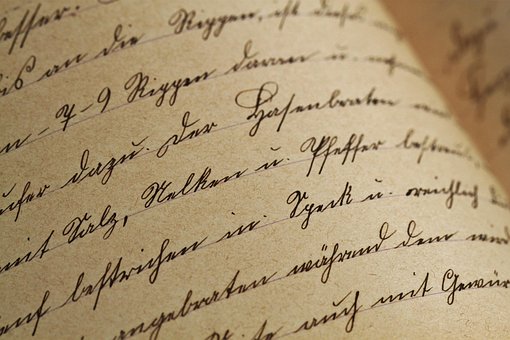 I'd like to start today's entry with a huge thank you to Adam Liss for the idea. He shared a link on the style of font and learning which was quite interesting and something I'd not heard about before.
After reading up on the topic, my first response was wow followed by "That makes sense." So here is information on the topic.
Most people think that if you change the size of the font, italicize it, Make it Bold, or other adjustment, it is going to help people retain the knowledge better. Research indicates this is not correct.
What they are finding is that it is better to use a font that is more difficult to read if you want people to remember the information. If you want to learn the information, we learn better if we have to struggle a bit so by using an unfamiliar difficult to read font, we are adding that bit of struggle.
If the fonts are familiar, we become over confident in thinking that we have retained the information when in reality we've only skimmed it for the essence of the material and really do not spend time learning it. When we have to slow down our reading speed, we are more likely to spend time really reading the piece while processing and learning the information.
According to a summary published by the University of Washington, researchers at Princeton conducted one experiment to see if the type of font would improve memory. Volunteers were given material printed in different fonts for 90 seconds. 15 minutes later, they were tested and the researchers discovered that 72.8% remembered the material printed with easy to read font while 86.5% remembered material printed with harder to read fonts such as Comic Sans.
A second experiment took place in several high school classes with the same level of abilities. The researchers changed the fonts on worksheets and power points. The results showed higher scores for all students who used the worksheets and power points written in a harder to read fonts. The thing about this experiment is that it was conducted at a school with teachers teaching at least two sections of each class. One class got materials using the normal fonts while the other class had the unfamiliar fonts.
The researchers concluded that this one simple change could improve learning. Their explanation for these results is that people must employ deeper processing strategies when using the harder to read fonts. So they have to think more about the material they are reading when its an unfamiliar font. This disfluency causes people to process information more deeply, abstractly, carefully, and better.
Just to let you know magazines and newspapers from the New York Times, to Wired, to the Harvard Business Review felt this information is significant enough to publish something on it. This study made an impact in the education field. They conclude that this is one easy thing to do to help students learn more.
I plan to use this with my students beginning in January. Let me know what you think. Thank you Adam for this. Have a good holiday.
Monday, December 25, 2017

Subscribe to:
Posts (Atom)