Showing posts with label Volume. Show all posts

Friday, November 18, 2016

Calculating volume

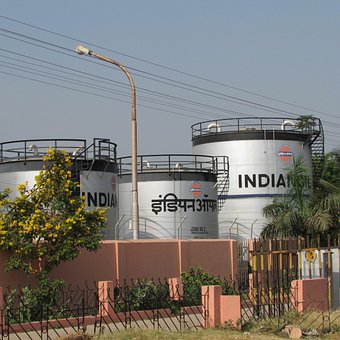
Railway Fuel Tanks, Hospet, India  The other day in class, during warm-ups, we discussed the words much vs many.  Since I work with ELL students, they are always mixing the two words up.

I explained that much is usually used with quantities that cannot be counted while many indicated countable quantities.

During the conversation, the topic of calculating the amount of fuel remaining in a tank came up.  This is something that has to be calculated when you buy or sell a house.  A nice real world application.

This skill is also great to know if you want to know how many gallons your fuel tank takes.  Up here in Alaska, most people heat with fuel oil so we buy several gallons at once and its stored in cylinders connected to the house.  In addition, there are water tanks which are cylindrical although I know someone who bought a rectangular shaped one for collected rain water.

So how does one calculate the volume of a tank sitting in your yard? If its cylindrical you measure the radius of the tank and the height(length)  Next you square the radius, multiply the result by the height or length. The final step is to multiply the result by 3.1415 to get the cubic volume but you still have to divide this figure by 231 to find the number of gallons.

To find the amount used, you could use a stick, dip it and based on the depth you could easily do an approximation of the volume left.  For instance if the diameter is 30 inches and the stick is covered up to 12 inches, then 12/30 or 2/5 is left so you can multiply 2/5 by the volume such as 200 gallons so you'd have 80 gallons left.

This could be extended to certain types of travel cups, cylindrical water troughs, columns to calculate the amount of cement needed, etc. 

On the other hand if you tank is rectangular, volume is simply length times width times height.  So to find the number of gallons by dividing by 231.  This would be great for calculating the amount of water for a pool, aquariums, holding tanks, etc.

So many real world applications and possibilities for students to work through.  Where are some places students might need to know this?  Let me know what you think.


Friday, May 24, 2013

Thoughts on the volume app

I have given some thought to the best way to use the volume app I mentioned a few blogs ago.  The videos are well done but it has a mechanical voice which may make my students dislike the videos  I am going to create a set of questions to answer as they watch the videos  This way they have to actually pay attention to what is being watched.  I am also going to include some problems based on the material in the videos so they have to attempt to work some problems to see if they understand the process. When they are done, they can check a QR code to see if they get the answers correct.  I am going to use those QR codes more often beginning in the fall. 
I am now on holidays but will spend the summer actually writing lesson plans and units with more integration of the iPad.  As I come up with ideas and plans, I"ll share the information with my readers.  I will be starting Monday and hope to post something from then.

Friday, May 17, 2013

App for teaching volume

I found a nice little app called Geometry: Volume of solids lite.  It has short videos explaining volume for rectangular prism, cylinder, sphere, pyramid and cone, the most common shapes our students are required to learn.  I downloaded it last night and plan to check it out over the weekend so I can give a more accurate review.  I watched a bit of the pyramid one and it had a 3 dimensional representation of the shape that turned around so students get a full look at all sides of it.  The introduction takes time to show how they derive the volume formulas for the shapes.  The best thing of all is that this is a free app.  I plan to explore other apps by this person.
Last day to get the book free.

Monday, April 15, 2013

logs and volume and surface area.

The project started off well.  One young lady discovered that they use logs in regard to determining pregnancy while the other discovered it is used for carbon dating of artifacts.  So they both had a great start.  I am going to do some research to see if I can find a website to help the geometry class work more on calculating surface area vs calculating volume.  Due to having to take time off, I did not use my usual introductory lesson on 3 dimensional shapes where I have them build actual models out of construction paper, and tape.  I need to find a program that will allow students to put pieces together to create 3D shapes on the iPad.  For instance,  a cylinder is made from two circles and a rectangle.  I use this lesson to help my hands on  and visual learners to see how the formulas for SA and Volume relate to the object.

I found a website  http://www.mathguide.com/lessons/SurfaceArea.html  which shows in wonderful detail how to find the surface area on various 3 dimensional shapes with a quiz to take afterwards for each shape.  This works on the iPad so I'm going to have my students try it tomorrow to see if it helps them increase their understanding for finding surface area.