Tuesday, April 30, 2019

Math News and Writing

Newspaper, Article, Journal, HeadlinesIt's sometimes difficult to integrate writing into math.  Yes, one can use journals, or writing prompts but there is a much better way of integrating writing into math and that is by having students read and then summarize articles either for publication in classroom magazine or into a journal.

I came across this idea in the article "Reading and Writing in the Math Class" by Alessandra King in Edutopia.  It was published on October 30, 2018.  In it, she discusses having students select math articles from the free app, Math Feed, summarize them and publish them in a classroom magazine.

She requires each student to read the article, summarize it, upload it with information on where they got the article from.  She then grades each student for understanding of the material, clear communication, editing, critical thinking in regard to the article and several other things.  She includes this as part of their overall grade.

There are lots of sources for finding mathematically based articles.  New York Times, Washington Post, The Economist, The New Scientist, Scientific American, or you can check out some digital sources who gather all the articles into one place.

1.  Mathfeed is a free app for apple devices.  The creator, Francis Edward Su, developed this app so it brings together articles from newspapers, influential blogs, podcasts, videos, and puzzle columns.  He did this while president of the Mathematical Association of America so it also includes their publications.

2. Math News from Phys.org has assembled math news into one location.  I saw one article where someone performed a statistical analysis on Beowulf and concluded it was written by a single author.  Another article analyzed over 4 million pitches to determine the rate of mistakes umpires make. I'm sure students would find one they liked.

3. Science Daily has a page filled with mathematical news.  They publish a few each day but have a long list under more mathematical news.  I saw one article about bee's being able to do basic math.

4.  Scientific American also has a page dedicated to mathematical news, starting with one on the mathematics of hacking. Another article uses data to determine which movies had the most influence on society. They looked at 47,000 movies to see which ones were referenced the most beginning with Gone With the Wind, followed by The Wizard of Oz and more.

5. New York Times has a page listing all the articles dealing with mathematics from the perfect formula of a heart at valentines day to the first women to win the Abel prize for mathematics.

6. The Independent over in the UK has a page with articles on mathematics. One articles states that 26 is the best age to get married at least as calculated by mathematics while another article looks at the perfect way to cut a pizza mathematically.

There are other sites out there you can use, all you need do is type in Mathematical News into the search engine.  If a student does not like the choices, have them find an article that interests them, check it out and decide if its a decent one.  If so, let them do it.  If your students have a lower reading level, check out Newsela because they have some math articles that can be found at three different reading levels.

One reason to include writing is that the act of writing involves both sides of the brain, the side that generates ideas and the side that puts the ideas into a structured form.  Furthermore, the slow pace of writing allows the student to construct their thoughts properly before writing.  In addition, writing helps clarify student thinking before they put their thoughts on paper and student writing gives the  teacher a chance to assess their understanding.

I plan to use this next year in math class to help improve reading and writing.  I've decided to let them create a video summary if they want but they still have to turn in a written summary.  Let me know what you think, I'd love to hear.  Have a great day.

Monday, April 29, 2019

Time for Prom

Interior, Luggage, Prom, Reception, PromWe have come to the time of year when students celebrate the end of the school year by attending a prom.  The prom at my school happened last night.  Usually the local prom is open to students beginning in 7th grade on up.  Sometimes folks from the village attend.  The prices are usually $20 per couple in formal, $25 single in formal, $25 per couple in casual, $30 for a single in casual. This gives students a four hour dance with food and music.  Usually, they arrive on snow machines or on an ATV.

Their cost is usually for the tickets, dress, shoes, or suit and tie.  Some of the boys borrow their suits from older brothers or even their fathers so overall the cost is not that much.  The girls get their hair done by friends, aunts, mothers or cousins, so again little or no cost but that is not true of most other proms.

This is the perfect opportunity to have students create a spread sheet covering the cost of everything associated with the prom.  For the girl, it would be the dress, her make-up, hair, jewelry, and shoes.  For the boy it would be the transportation such as a limo or car, suit, shoes, tickets, perhaps even a room at the hotel where the prom is held.  There might be a cost for a dinner before the prom or an activity after the prom.

I would be interesting to compare the prices they paid with the national averages.  According to an article with money magazine, the average cost of attending the prom in 2013 was $1,139. The average dropped to $978 in 2014 and dropped again to $919.  According to a survey done by American Express, going to a wedding is likely to cost between $703 and $893.

Furthermore, the cost of attending the prom varies according to part of the country, and location within that area.  A person is more likely to spend more in New York City than in Topika Kansas.  If you lived in the northeastern part of the country, you would be likely to spend over $1,100.

 In addition, according to another survey, families who made less than $25,000 spent almost $1,400 for the prom while those who earned over $50,000 per year spent closer to $700.  The thought behind this discrepancy is those in the under $25,000 knew this might be the only big thing the children would attend so wanted to make it special.

This site shows the change in the average cost of proms from 1998 to 2014 as compared with the general consumer prices.  He even offers a spread sheet called Prom Price Index which people can change amounts to see how the overall price changes.

This site looks at 23 different statistics concerning prom both in the United States, Canada, and other seas. This goes so far as to look at how much of the prom costs parents will cover, cost of shoes, dresses, etc, and amount spent based on income.  It also looks at external costs of prom based on alcohol consumption.

Lots of fun stats to use and compare.  Let me know what you think, I'd love to hear.  Have a great day.

Sunday, April 28, 2019

Warm-up

Former Prison, Historic, Building

If the building is 150 feet long, 80 feet wide and 125 feet tall, how much paint will be needed to repaint the outside of the building.  Do not worry about the windows.

Saturday, April 27, 2019

Warm-up

Iceland, Waterfall, Seljalandsfoss

If the equation for the distance water falls is d=16*t^2 where t represents time and d is distance, how far did the fall if it took the water 6 seconds to fall to the lake.

Friday, April 26, 2019

Square Root Day

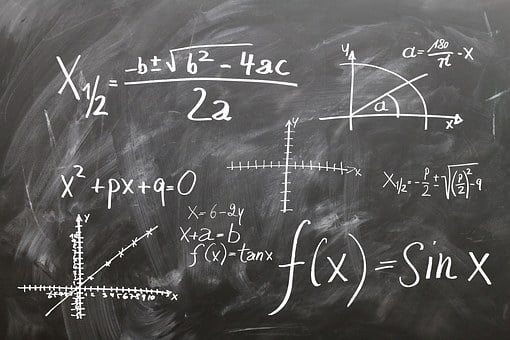
Mathematics, Formula, Physics, SchoolSquare roots are found all other the place in math classes.  Aside from finding the square root of a number, one of the most familiar uses is in the quadratic formula for finding roots of quadratic equations.  One of my coworkers is finishing off a math class and she's been using this formula a lot.

Did you know there is an unofficial holiday referred to as Square Root Day?  Its only been around since 1981, when Ron Gordon held the first square root day on September 9, 1981. Ron Gordon was working as a high school drivers ed teacher at the time.


It was noticed that September 9, 1981 when expressed as 09/09/81 made the perfect square root because 9 x 9 = 81 and 9 is the square root of 81. If you look at all the days in a century, you'll discover that only 9 days meet this criteria. For the 21st century, these are the square root days.

  • February 2, 2004 (02/02/04): 2 X 2 or 2² = 4
  • March 3, 2009 (03/03/09): 3 X 3 or 3² = 9
  • April 4, 2016 (04/04/16): 4 X 4 or 4² = 16
  • May 5, 2025 (05/05/25): 5 X 5 or 5² = 25
  • June 6, 2036 (06/06/36): 6 X 6 or 6² = 36
  • July 7, 2049 (07/07/49): 7 X 7 or 7² = 49
  • August 8, 2064 (08/08/64): 8 X 8 or 8² = 64
  • September 9, 2081 (09/09/81): 9 X 9 or 9² = 81
The last one occurred on April 4, 2016 and the next one won't be for another 6 years on May 5, 2025.  now for some fun facts about square roots.

1. The first square root sign first appeared in print back in 1525 in the book Cross which also contained the modern + and - for addition and subtraction.

2.  Yale University has a Babylonian Tablet containing the value of the square root of 2 to nine decimal places.  The table is about 4000 years old.

3. The Rhind Mathematical Papyrus, dating back to 1650 BC, shows that Ancient Egyptians had the ability to calculate square roots, along finding slopes.

4. There are clocks out there that show the time in square roots such as noon is the square root of 144.

5.  Even Ancient India had a way of finding square roots and they used square roots as far back as 800 BC.  

I stumbled across this holiday and when 2025 comes around, I'll be ready to celebrate.  Let me know what you think, I'd love to hear.  Have a great day.

Thursday, April 25, 2019

Reading in Math

Knowledge, Book, Library, GlassesMy students hate to read in general and they hate reading textbooks.  I suspect much of their dislike has to do with their low reading levels.  Over half of my high students are still reading at about a fifth grade level.  So I've had to include reading as part of what I teach.

The cool thing about reading is that it is a two stage process, just as learning math.  The first stage involves the transfer of encoded information to the reader and second, the reader needs to understand the material.

Unfortunately, reading math text does not always involve the reading skills normally taught in English or in reading classes.  Reading math often requires skills specific to math itself.  I know, I was never taught to teach students the reading strategies needed to successfully read a text.  I'm also aware, most elementary teachers do not teach those strategies to their students so students get to high school without that ability.

The differences in reading a math textbook vs a regular book are many.  For instance, research indicates that sentences in math textbooks have more concepts per sentence and paragraph.  This means the material is extremely information dense.  These sentences are filled with lots of information but little repetition.

Another difference is that many sentences contain both numeric and non-numeric symbols laid out in paragraphs that may be in different arrangements with graphs, examples, and other visuals making it more difficult to read using the usual left to right eye movement.

In addition, math books often have sidebars with information that may or may not be relevant to the topic.  The material in these sidebars may be confusing to students because most English textbooks do not have any so a student may not know how to sort through them.

Furthermore, most math textbooks do not follow the standard form of topic sentence and support sentences for each paragraph as found in most other paragraphs.  In a math textbook, the key idea is at the end, not at the beginning.  This is especially true for word problems, when the sentence asking students to find something normally appears.  It its important for the student to read through the material to find the "main idea" before rereading to find the "support" information.

There is also the problem of vocabulary and the words having slightly different meanings within the context.  For instant 3 - 2 to many people is read as "three minus two" but it can also mean "three plus a negative two".  Both the same thing but the second way often confuses students.  In addition, words often have a meaning in English and a different one in Math so students have to know both meanings.

Add to that, the use of certain small words in Math such as "of" and "off" or "a" meaning any number, or something "of" for say the area of a rectangle, meaning inside not multiplication.  There was a study done where students were specifically taught these small words, and their ability to do math improved because they understood the differences.

There is a specific set of strategies students can use with a math textbook to improve their reading.  First students can preview the text by looking at the title, all headings and subheadings and using it to activate prior knowledge which in this case might be where they've used it before or done something similar. Students could also write out questions they have about the topic based on their previewing.

Next they figure out the major concept covered in the material along with determining is they know the specialized vocabulary, and see if they can connect it to real life.  At the same time, the teacher can prepare by finding the major concept and are their pieces in the reading they may not have the vocabulary or are unable to figure out the meaning through context.  The teacher also needs to know if they need to use supplemental materials to improve understanding of the topic.

It is important to use a variety of graphic organizers from the Frayer Model for new vocabulary words to analysis grids for separating the characteristics of quadratics or other shapes, to a flow chart on processes.

One source suggests teaching students to use the  SQRQCQ for word problems.
Survey - Read the material quickly to get a general understanding.
Question -  Question yourself to figure out what the problem needs to be answered.
Reread - Reread the problem to find the details needed.
Question - Ask what operations need to be performed in what order.
Computations - Do the calculations.
Question - Does the answer look reasonable?


I've taught my students the "Kentucky Fried Chicken Wings" method to answer questions.

K - What do I know?  What information did they give me?
F - What do I have to find?
C - What else do I need?  What formula?  What operations and in what order?
W - Do the work and find the answer.

This is an introduction to integrating reading instruction into the classroom.  Let me know what you think, I'd love to hear.  Have a great day.


Wednesday, April 24, 2019

Compromise with calculators.

Accountant, Accounting, Adviser, AdvisorI have a class of 9th graders who are so far behind, they test at about a 3rd or 4th grade level on everything from MAPs to MobyMax. Today, I discovered why they do not seem to know their multiplication tables or have trouble adding and subtracting.  The middle school math teacher let them use a calculator for all math that required a numerical answer.

At this point in time, I do not have the time to fully remediate their weaknesses and get them up to speed, so I've figured out a compromise to help them learn the processes but still allows the use off a calculator.

Right now, I have groups of students practicing their long division such as two digits into three digits or two digits into 5 or 6 with a decimal.  Say the problem is 452/28.  I let them use the calculator to do 45/28 so they know how many times it goes which is 1 and something.  They take 1 x 28 and put the answer - 28 below the 45 and then subtract.  Again they may use the calculator to subtract to get 17.  They write the 17 below and then bring down the 2 so they have 172.

They again divide 172 by 28 to get a whole number.  It is 6 times and a remainder so they can multiply 6 x 28 to get 168 which they write below 172 so they can subtract and get a remainder of 4.  The problem would look like this.

     
This way, the students show the work following the standard algorithm while doing the correct math and experiencing success instead of getting frustrated because they don't know their multiplication tables.  It's going much better because the students are willing to try and they are no longer spending all their time trying to remember their multiplication tables 

I am doing the same thing with the students who are dividing a two digit whole number into five or six digits with a decimal in it.  This group instead of complaining and refusing to work is willing to follow this method.  

I hope by doing it this way, they learn more about the process without getting stuck and discouraged. I am doing it out of desperation because if I make them do it without the calculators too many students give up and shut down.

Let me know what you think, I'd love to hear.  I don't know if this is the best choice but its worth a try.  Have a great day.