Wednesday, November 6, 2019

Mobile Devices + Children's Brains = ?

Selfie, Children, Phone, AsiaIt seems like everyone in today's society owns some sort of mobile device.  Most seem to own a cell phone which they use for everything.  Unfortunately, it appears these devices are used by all age groups.

It appears that one quarter of the children between the ages of 2 and 5 have their own smartphone.  The percent increases to over half of the children aged 11 to 13 own a cell phone but over 70 percent of that age group know how to use them.

Most education is based on Piaget's work.  He believed that children through their experiences of the world around them construct new ideas based on what they observe.  Researchers have noticed a decrease in interactions between parents and children meaning these devices are interfering with the process of bonding.

Furthermore, children learn about language, emotions, how to have a conversation, learning to read facial expressions, but decreased interaction time means children are missing out on developmental milestones.

Although it has not been proven that cell phones emit radiation, they do emit radio waves which can damage brain development.  In addition, it does appear that the use of technology changes the parts the brain uses.  One doctor did brain scans of two groups of people.  The first group was made up of people who were very technology savvy while the other group didn't use it.  The results show the first group showed lots of activity in the dorsolateral prefrontal cortex area but the second group show that activity.  However, the second group began showing that same type of brain activity after learning to use the devices.

Initial research indicates that children who use mobile devices are not using the brain circuits that control the learning of reading, writing, and concentration.  Screen time also effects their ability to communicate, the development of their emotions, and impact their people skills.  In addition, there is evidence to indicate that too much screen time can decrease cognitive skills with as little as two hours a day of use or cause changes to the brain if the child is on the device for more than 7 hours a day.

There are indications that using a device can make your brain lazy because the brain no longer has to remember phone numbers or information because the device can remember it or help find answers via  various search engines.  It is much easier to look it up online than to remember it.

Research has also found that use of mobile devices can impact the amount of sleep children get each night.  Devices throw out a blue light that fools our bodies into thinking it is daylight by decreasing the amount of melatonin produced so it no longer follows our natural circadian rhythm.

There are studies out there that are currently underway to monitor children's brains over the next few years but many educators have serious concerns about how these devices effect the development of the brains.  This could lead to an overall change of educational theory and teaching methods.  Let me know what you think, I'd love to hear.

Tuesday, November 5, 2019

Small Paper Books.

 My school district is having a three day inservice with all the teachers meeting in one place.  The district flew everyone in from the various sites to enjoy some really awesome training.

One of the sessions I attended was on art in the classroom.  It had some things like tableaus I was not particularly interested in because I wasn't sure how to integrate them into the math classroom.,  There was one activity I could see integrating into my classroom.

It was on using a six page book made out of one piece of paper.  Basically, you fold one sheet of  paper into 8 equal parts.  Once this is done, you fold the paper in half using a hamburger fold and cut from the fold in to the next fold so you have a slit running ac ross two sections in the middle.  Push it together, wrap and you have a book.
 The instructor recommended we create a book on a topic we'll be teaching sometime before December.  The idea is that we make a book so we know how easy it is and then we'll have our students make some.

I decided to make one on compound inequalities for my Algebra I class but honestly, I'm not sure I can get them to make any because they are more "Math is to torture humans", than wanting to try.

I drew the front page using pen but colored in the words using a colored pencil.  I didn't know about the colored pencils until I got it done.

The next page, I devoted to real life examples of "and" compound inequalities for putting gas in the tank or bullets in a handgun.  Out here, students regularly use guns for hunting but since I didn't know how many bullets a normal rifle held, I settled for using a hand gun.

I wrote an explanation for the and so they could see the and is actually two equations combined into one.
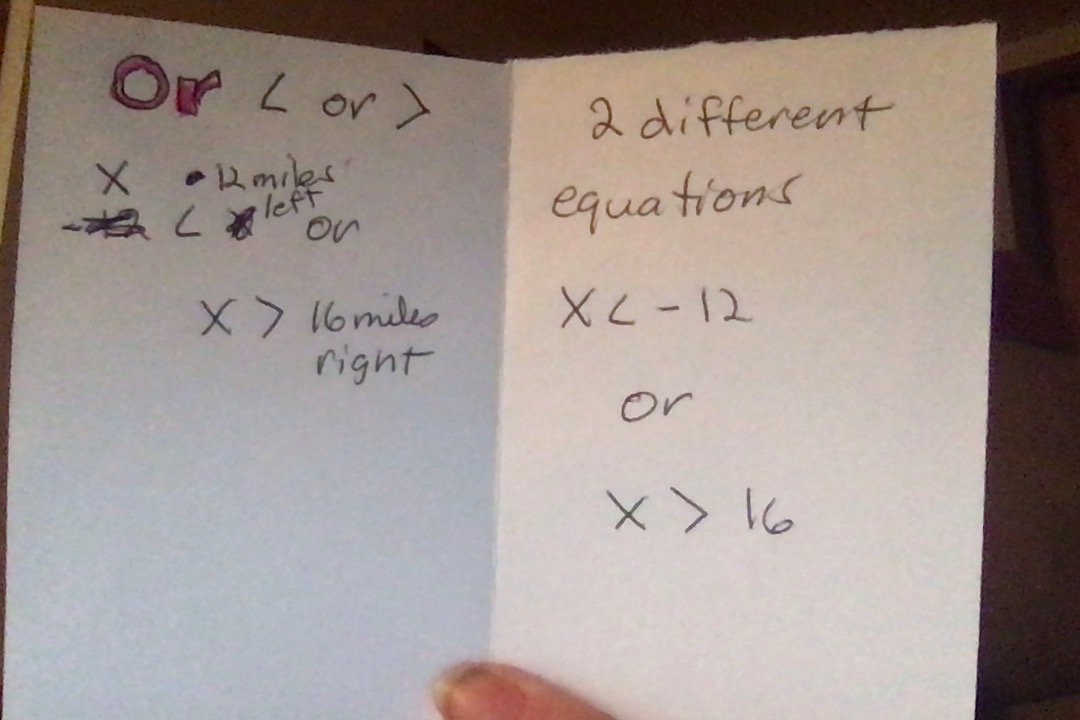
The next set of pages focused on "or"'s using distance.  The fish are up to 12 miles south or more than 16 miles north.  South being the negative direction while north is positive.

I then wrote out the equations for the or and the final page showed the graphs for each one.  I think I need to redo the book and improve on my writing and the way its organized.

This is the best suggestion for art the presenter had in her arsenal.  I really enjoyed making the book but I had more fun making geometric lights.  I'll talk about that later.

Let me know what you think, I'd love to hear.  Have a great day.

Monday, November 4, 2019

Compound Inequalities are All Around Us.

Greater Than, More Than, Math, Greater  I am getting ready to teach compound inequalities to my Algebra I students and have been trying to think of some real world situations they might relate to.  It is fine and good to teach it using variables and such but without a context, it remains a mystery for most.

Most of the examples I've seen are ones my students will not be able to relate to such as using more gas if you drive too slow or two fast but if I change it to talk about filling the gas tank up it will make more sense.  If the tank takes a maximum of 5 gallons gas in their ATV, then they will add between 0 and 5 gallons or 0 <x< 5. The above example will make more sense to them because its a better context.

Another example is one involved video games.  On the level they have a certain number of tries to eliminate all the trees in front of them.  Say they are given 6 bombs to accomplish the feat so the compound inequality would be 0 <x< 6 because once they run out, they cannot do more.  This type of inequality appears in numerous video games.

You are planning a trip.  You are looking at going to either Mexico or Hawaii and the airfare is about the same but the hotel room cost is quite different.  The room in Mexico is $75 per night while the room in Hawaii is $152 per night so you have an or.  x > $75 or x$152 and the x is based on how many nights you will spend there based on a minimum of one night. This is an example from my life.  I ended up going to Mexico due to the cheaper cost of hotel rooms for the Christmas Holidays.

Another example is when looking at renting cars.  Depending on the time, the company, and length, one rental company may be a much better deal.  For instance, Hertz may offer you a full sized car for $87.50 per day while Avis has the same for for $92.00 so your inequality becomes x > $87.50 or x > $92.00.

You always see examples that are like x > 32 or x < -15 so what would that be in a real world situation?  If you think of the minus sign as a direction, then you can look at it this way.  You are visiting your aunt in Fresno.  You want to go to a game store but you are between two.  One is 32 minutes heading towards the mountains, or 15 minutes towards the ocean.  These do not involve equals because anyone who has driven in traffic knows the time is usually the minimum time. Another scenario for x > 32 or x - 15 is that my friend and I went on a diet, she lost at least 15 pounds on it while I gained 32 pounds using the same diet.

One compound inequality I see all the time involves buying things on sale at fabric or grocery stores. When fabric stores offer patterns on sale for $1.99, they put a limit of 10 patterns on it or 0 <x < 10.  Often there are limits on butter at $1.69 per pound instead of $2.69 per pound.  You might be restricted to 5 pounds.

Even when traveling on the airline, you are allowed to have up to 50 pounds in your luggage so it has to be between 0 and 50 or they might charge you an additional fee.  Most airlines also allow you so many suitcases free before you are charged for extra bags.  Some airlines in Alaska do not charge by the piece, they charge by a total weight for your check through and carry on bags.  I've used an airline that had a maximum of 100 pounds before they charge you almost $1.00 per pound overage.  So you made sure the weight was no more than 100 pounds.

So as you can see, the world is filled with lots of compound inequalities.  Let me know what you think, I'd love to hear.  Have a great day.

Sunday, November 3, 2019

Warm-up

Mobile, Phone, Iphone, Music, Technology

Your device has 60,252 minutes of music, how many hours of music do you have?


Saturday, November 2, 2019

Warm-up

Ipad, Samsung, Music, Play, Google

You have 22 hours of music on your device. If there is an average of 19 songs per hour, how many songs do you have?

Friday, November 1, 2019

Amusement Parks and Rides.

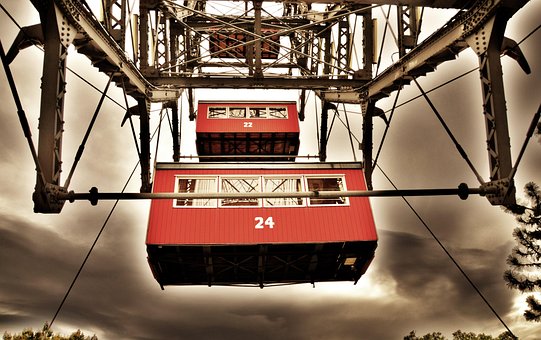
Ferris Wheel, Vienna, Prater, AustriaThere are so many of them spread across the United States.  Many you'll recognize like Knotts Berry Farms, Disney World, Disneyland, or Six Flags but there are  so many more.  I love visiting Disneyland when I can, even with the long lines yet each ride is an investment  for the company.

The price of a ride depends on things like its size, the cost of the materials used to build it, and demand for the ride.  An outdoor ride can run between $90,000 and $300,000 but it is possible a single ride could cost more than $800,000.

Now if you want to look at the price of building an amusement park from scratch, its cost depends upon the size of the finished park.  For instance, if you want to build a mega park like Disney or Universal, it is projected to run between $2,000,000,000 and $4,000,000,000 while a regional theme park will probably cost between $200 million and $500 million.  Although it is possible to build a water park for less than one million, most cost in the $10 million to $40 million to build.

On the other hand, only the mega parks are capable of producing over $1 billion in revenues but they have to spend to get those revenues.  For Disneyland, it is not unusual to spend between $30 million and $100 million for one attraction.  One reason they spend so much money is that they are competing with themselves and forms of entertainments that didn't previously exist.

If you want to provide some in-depth information on the business of amusement parks, check this site.  The article is in two parts.  The first part covers the amount of money parks make while the second part focuses on the amount the parks cost and what they earn.  Furthermore, this two part article is filled with lots of graphs, detailed information, and figures.  The figures can be used to create graphs to interpret the data.  It also explains why certain costs change.

I chose this topic because there is a lot of math involved from the land to the final product and it covers things you don't normally think about.  Let me know what you think, I'd love to hear.  Have a great evening.